Apple’s New Hardware Lease Skips Canada—for Now
Matthew Leo · Published July 28, 2026 · Business & Policy
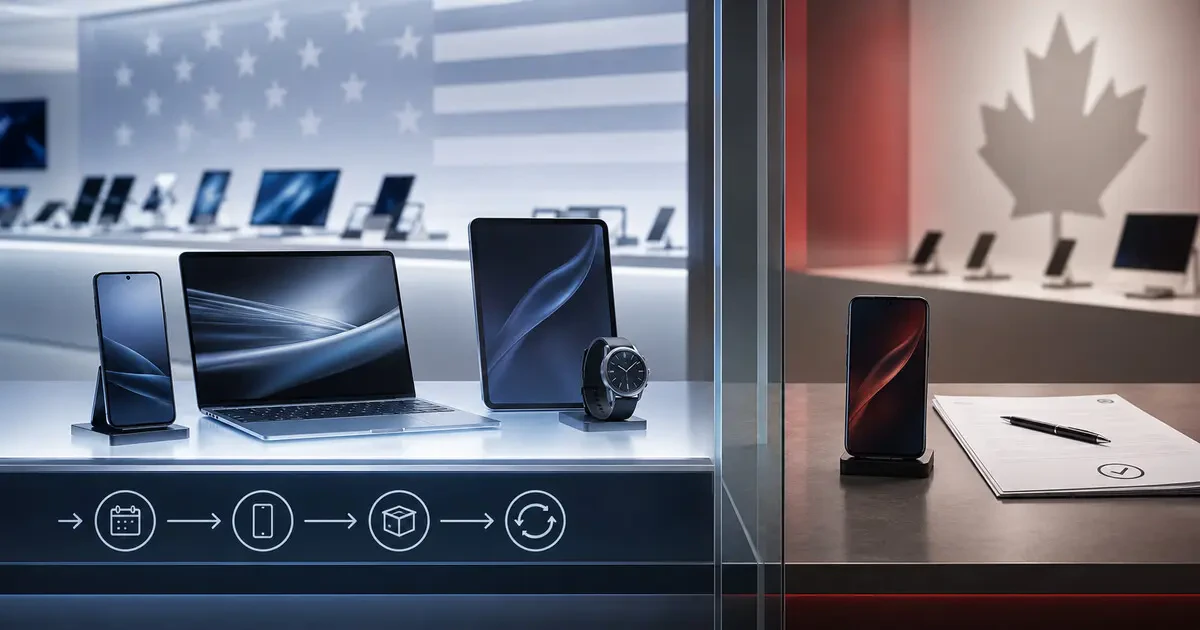
Apple has made its hardware feel cheaper in the United States by turning ownership into an optional extra.
The company launched Apple Upgrade on July 28, a U.S. program that lets customers lease eligible iPhones, Macs, iPads and Apple Watches through monthly payments.
At the end of the lease, customers can return the device and move to another eligible product. Apple’s U.S. shopping page describes the arrangement plainly: choose a product and term, make monthly payments, then return the current device when upgrading.
The program is not currently offered to Canadian consumers. Apple has not announced whether that will change.
Leasing and financing are not the same thing
| Question | Traditional financing | Apple Upgrade lease |
|---|---|---|
| Who owns the device after regular payments? | The customer | The device is normally returned unless another option is exercised |
| Why are payments lower? | The full purchase price is repaid | Payments reflect use during the lease term |
| What happens when upgrading? | The customer can keep, sell or trade the old device | The leased device is returned under the program |
A lower monthly payment can be useful. It is not proof of a lower total cost.
Someone who buys a phone and keeps it for four or five years can spread the purchase price across a much longer useful life. A customer who repeatedly leases stays inside a continuous payment cycle and gives up the ability to privately sell the device.
What Canadians can currently use
Apple’s Canadian store currently offers financing through Affirm.
At the time of checking, iPhone purchases were available at zero per cent interest over 24 months. Apple listed different rates and terms for other categories: 4.99 per cent over 12 months for iPad and Apple Watch, and 7.99 per cent over 24 months for Mac.
Those rates can change. Customers should check the cost of borrowing shown at checkout rather than assuming that every Apple product receives the iPhone’s zero-per-cent offer.
Financing results in ownership after the scheduled payments. The customer can then keep the device, trade it in or sell it independently.
Why Apple wants leasing
Leasing reduces the monthly number displayed beside increasingly expensive hardware. That can keep a premium device within psychological reach even when its full price has climbed.
It can also create a predictable stream of returned devices. Those products may be refurbished, resold or recycled, depending on condition and program terms.
The arrangement also encourages customers to remain inside Apple’s upgrade cycle. Returning one Apple product becomes the route to obtaining the next one.
None of that makes leasing inherently unfair. Businesses have leased technology for years because predictable refresh schedules can be more useful than ownership.
Consumers should simply recognize whose problem the program solves. It lowers the immediate payment and simplifies frequent upgrades. It does not necessarily minimize long-term spending.
A Canadian comparison needs the actual lease terms
If Apple brings the program to Canada, the useful question will not be whether the monthly payment looks affordable.
Canadians should compare:
- Total lease payments over the full term.
- The amount required to keep the device.
- Early-upgrade and early-termination costs.
- Damage standards when returning hardware.
- Whether AppleCare is included or separate.
- The likely resale value of a financed device.
- The interest rate on the closest ownership alternative.
Without those Canadian terms, calculating whether the program would be a good local deal would be speculation.
Ownership remains underrated
Apple devices generally receive years of software support and often retain meaningful resale value. Those characteristics strengthen the case for keeping a product beyond its financing period.
Mapletechie reached a similar conclusion while examining Samsung’s foldable upgrade arrangements: turning a luxury purchase into a monthly cycle can soften the price without making the product genuinely affordable.
Apple Upgrade may suit Americans who replace devices frequently and value convenience more than ownership. Canadian buyers are not currently missing an obvious bargain.
They are missing another payment model—and until Apple publishes Canadian prices and terms, that distinction is the honest one.
Tags: Apple, Apple Upgrade, device leasing, Canadian financing, consumer technology