August 12 Eclipse and Perseids: What Canada Will See
Matthew Leo · Published August 13, 2026 · Guides
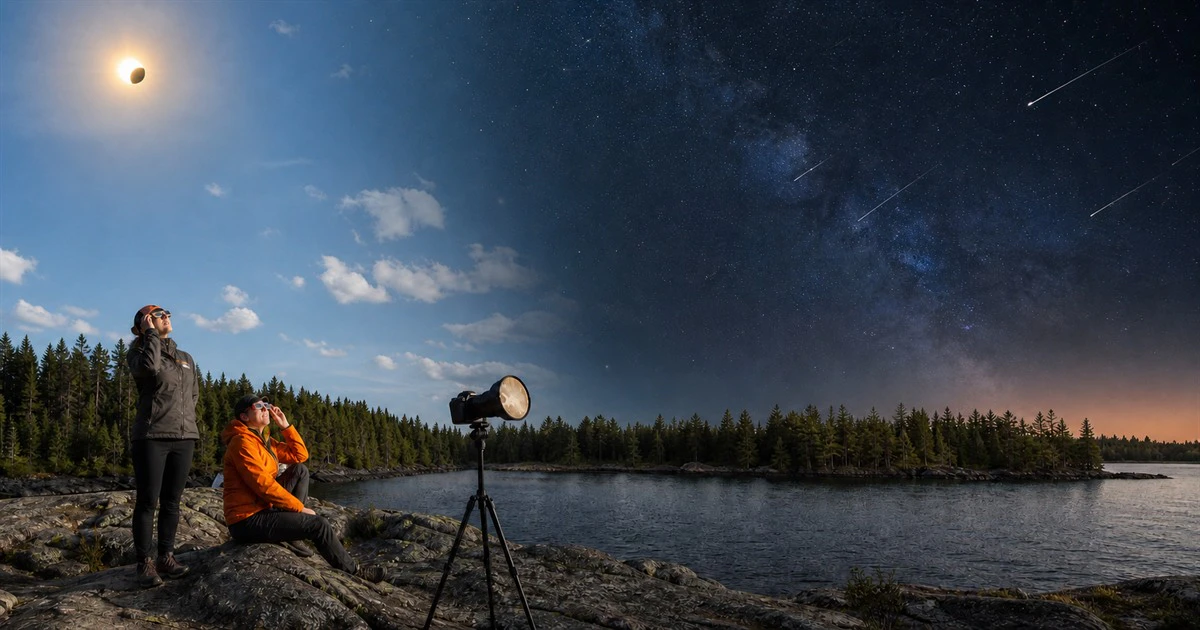
Canada gets two sky shows on August 12: a bite out of the afternoon Sun and a moonless night of Perseid meteors.
The solar eclipse will be total across a narrow path through Greenland, Iceland, northern Russia, Spain and a small part of Portugal. Canada is outside that path, so Canadians will see a partial eclipse only. Hours later, the Perseid meteor shower reaches its annual peak under a new Moon, giving much of the country unusually dark conditions.
The events need opposite equipment. The eclipse requires certified eye protection every second you look toward the Sun. The meteor shower is safest and easiest with no telescope at all.
What the eclipse will look like in Canada
The NASA visibility guide says most of Canada will see at least part of the eclipse. The effect grows stronger toward the east and north. It will be modest in southern Ontario and more obvious in Atlantic Canada, northern Quebec and Nunavut.
NASA lists Toronto’s partial phase from 12:55 p.m. to 2:23 p.m. EDT, with maximum eclipse at 1:40 p.m. and about 8% of the Sun covered. Halifax runs from 1:58 p.m. to 3:58 p.m. ADT, with maximum at 3:00 p.m. and about 31% covered. Local times and coverage vary, so use NASA’s interactive map or a location-specific eclipse calculator before making plans.
In Thunder Bay, the partial phase begins around midday and peaks shortly after 12:30 p.m. local time. The exact contact time depends on the calculation source and observer location, so arrive early rather than treating one minute as a starting gun.
Do not expect the sky to become dark in cities where only a small part of the Sun is covered. A partial eclipse can be easy to miss without glasses because the remaining sunlight is still intense. The sight is the changing shape of the Sun, not a sudden night in the middle of the day.
There is no safe naked-eye phase in Canada
The Canadian Space Agency says eclipse glasses must use filters designed for solar viewing and comply with the ISO 12312-2 standard. Ordinary sunglasses are not enough, even if they are very dark.
Inspect eclipse glasses before use. Discard them if the filter is torn, punctured, scratched or separating from the frame. Put them on before looking toward the Sun, then turn away before removing them. Supervise children directly.
Never look through binoculars, a camera viewfinder or a telescope while wearing eclipse glasses. Concentrated sunlight can damage the filter and the eye behind it. Optical equipment needs a properly fitted solar filter secured over the front opening, before sunlight enters the instrument. A filter attached only to the eyepiece is dangerous.
A simple indirect method is safer when certified glasses are unavailable. Punch a small round hole in one piece of card and let sunlight pass through it onto a second light surface. The projected spot will show the changing solar shape. Face away from the Sun while viewing the projection, and never look through the hole.
The Perseids peak after dark
The International Meteor Organization’s 2026 calendar places the main Perseid maximum between 2:00 and 4:00 UTC on August 13. That corresponds to late evening on August 12 across Canada. The shower remains active from July 17 to August 24, so the nights around the peak can still be worthwhile if clouds interfere.
The published zenithal hourly rate is 100. That is not a promise that one person will count 100 meteors from a backyard. It is a standardized estimate for an observer under an exceptionally dark, clear sky with the radiant overhead and a wide view. City light, haze, trees and the radiant’s position reduce the real count.
The good news is the Moon. August 12 is a new Moon, so moonlight will not wash out the fainter trails. The biggest remaining variables are cloud and artificial light.
How to get the best view
- Check the hour-by-hour cloud forecast. A famous peak means little beneath solid cloud. Be ready to use the night before or after.
- Move away from direct lights. A dark park, rural property or lakeshore is better than a lit parking lot. Follow local access rules and do not stop on a highway shoulder.
- Give your eyes time. Avoid bright phone screens for about 20 minutes. Use the dimmest red-light setting you can manage.
- Look broadly. Meteors can cross any part of the sky. A reclining chair and a wide open view are more useful than a telescope.
- Dress warmer than expected. Even an August night can feel cold when you sit still near water. Bring layers, insect protection and a blanket.
The meteors appear to trace back toward the constellation Perseus, but staring only at the radiant produces shorter-looking trails. Look roughly halfway up the sky, away from the brightest local glow.
Phone and camera tips that do not ruin the night
A phone can capture a bright meteor by luck, but video mode and handheld night shots usually disappoint. Use a tripod or stable support, select the main rear camera, turn off the flash and use a night or manual mode that can hold the shutter open for several seconds. Take repeated frames instead of trying to react after seeing a streak.
For a larger camera, start with a wide lens, a sturdy tripod, manual focus near infinity and exposures short enough to keep stars reasonably sharp. Test ISO and shutter time against the actual sky rather than copying one universal setting. A dark sky can tolerate a longer exposure than a bright suburban one.
Do not improvise a solar filter for daytime photography. A neutral-density filter, smoked glass or stacked sunglasses are not substitutes for a certified front-mounted solar filter. The eclipse is not worth damaging a sensor, lens or eye.
Mapletechie’s practical guides focus on technology that helps rather than distracts. For this double-header, that means checking the exact local time, protecting your eyes, dimming the phone and then looking up.
Canada will not get totality on August 12. It will get something more accessible: a partial eclipse in the afternoon and a dark, meteor-friendly sky at night. With safe glasses, clear weather and a patient hour outdoors, both are worth seeing.