Borrow Ottawa’s Five Frontier-AI Cyber Controls
Matthew Leo · Published October 23, 2026 · Guides

Ottawa’s new frontier-AI cybersecurity direction is mandatory for covered federal organizations, not a new law for every Canadian company. Still, its priorities make a useful checklist for private and non-profit teams that need to prepare for faster vulnerability discovery, more convincing impersonation and less time to contain an intrusion.
The Security Policy Implementation Notice took effect on October 1, 2026. It tells departments and agencies to apply baseline controls consistently, fix material gaps that AI-enabled attackers could exploit and operate under an “assume breach” model that limits the blast radius and speeds recovery.
The practical value is that it does not ask organizations to predict a science-fiction attack. It starts with neglected devices, identities, network boundaries and backups.
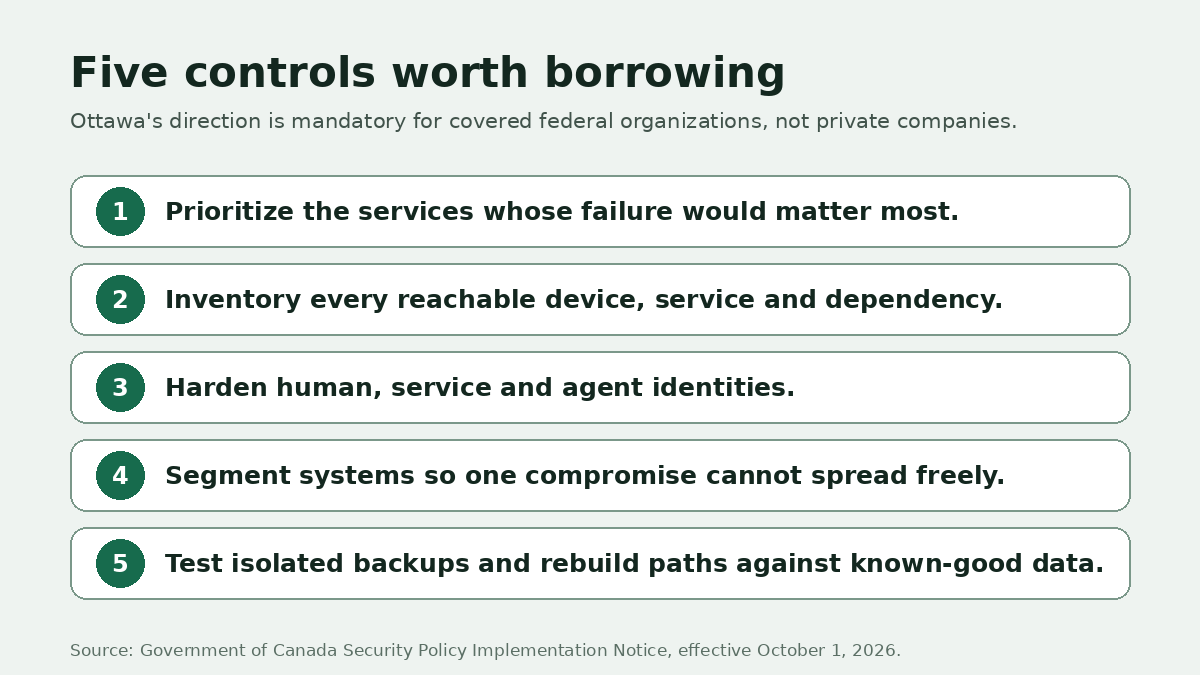 Five controls private organizations can borrow from the federal direction. The notice itself applies only to organizations covered by the federal Policy on Government Security.
1. Start with the services that cannot quietly fail
The federal direction tells organizations to identify their most critical services and the applications, infrastructure, devices, integrations and data that support them. It calls these the “crown jewels.”
A private organization can do the same without a months-long classification project. Pick three to five services whose loss would stop revenue, safety, payroll, customer support or a legal obligation. For each one, name an accountable owner and write down:
the application and data it needs;
the identity provider and administrator accounts that control it;
the network, cloud and vendor dependencies it relies on;
the backup and restore path; and
the longest tolerable interruption.
This prevents a familiar failure: applying the same control effort to every system while the most important service still has an undocumented dependency.
2. Inventory every reachable device, including the boring ones
The notice’s scope is deliberately broad. It includes servers, workstations, mobile devices, routers, firewalls, Internet of Things equipment, networked laboratory systems and printers, whether on premises, roaming or in managed cloud environments.
That list is a reminder that attackers do not care which asset appears on the executive dashboard. A forgotten printer, remote-management interface or lab controller can provide a foothold.
Build the inventory from more than a spreadsheet. Compare procurement records, identity logs, network discovery, cloud accounts, endpoint-management data and vulnerability scans. Anything reachable by IPv4 or IPv6 needs an owner, a purpose, a patch path and a retirement decision.
3. Treat AI agents as identities, not software features
Ottawa’s identity section covers human accounts and non-person entities such as service accounts, service principals, machine identities and AI agents. It calls for clear ownership, a documented business purpose, lifecycle management and regular privilege reviews.
For an AI agent, record:
which tools and data it can reach;
whether it can make an irreversible change;
where its credentials are stored;
who reviews its actions and exceptions;
how access is disabled when the workflow ends; and
which logs prove what it did.
Use phishing-resistant multi-factor authentication for administrators, separate administrative accounts from everyday browsing and email, and minimize static credentials. An agent account that is permanently privileged is a service account problem with a faster operator.
4. Design for containment after one control fails
“Assume breach” does not mean accepting defeat. It means designing the environment so one stolen account or exploited device cannot reach everything.
Separate user devices, administrative systems, production workloads, backups and high-risk operational technology. Restrict east-west traffic between network segments. Put management interfaces on dedicated paths. Require fresh authorization for sensitive actions rather than letting a long-lived session cross every boundary.
Then test the boundaries. A diagram that shows segmentation is not proof that firewall rules, cloud security groups and service-to-service permissions enforce it.
5. Test a recovery that the attacker cannot rewrite
The federal direction calls for regular restore tests and verification against a known-good reference. It also says backups for critical services should be logically separated from production and, where feasible, immutable or write-once.
A useful restore test answers more than “Did the file copy back?” Check whether identity services, encryption keys, configuration, vendor access and network routes can be rebuilt. Record the time, manual steps and missing knowledge. Assume the production administrator account may be compromised during the recovery.
The Canadian Centre for Cyber Security goes further for critical infrastructure. Its frontier-AI guidance says operators should prepare to isolate systems for up to three months, operate independently and rebuild after a severe incident. That is a demanding benchmark, but it exposes dependencies that a one-day tabletop exercise can miss.
A 30-day way to use the checklist
Week 1: Choose the critical services and assign owners.
Week 2: Reconcile asset and identity inventories around those services.
Week 3: Remove unnecessary access, close exposed management paths and document agent accounts.
Week 4: Restore one service into an isolated environment and record what breaks.
Do not claim compliance with the federal notice unless your organization is actually covered and has assessed every applicable requirement. For most businesses, this is a source of priorities, not a certification framework.
Read the Government of Canada direction for the full set of controls and the Cyber Centre’s frontier-AI guidance for broader Canadian recommendations. Independent Canadian analysis from Fabric Networks confirms the notice’s October 1 effective date and its application to organizations under the Policy on Government Security.
Tags: frontier AI, cybersecurity, Government of Canada, assume breach, AI agents