Canada’s Tariff Fight Is Coming for Electronics Next
Matthew Leo · Published August 29, 2026 · Canada Tech
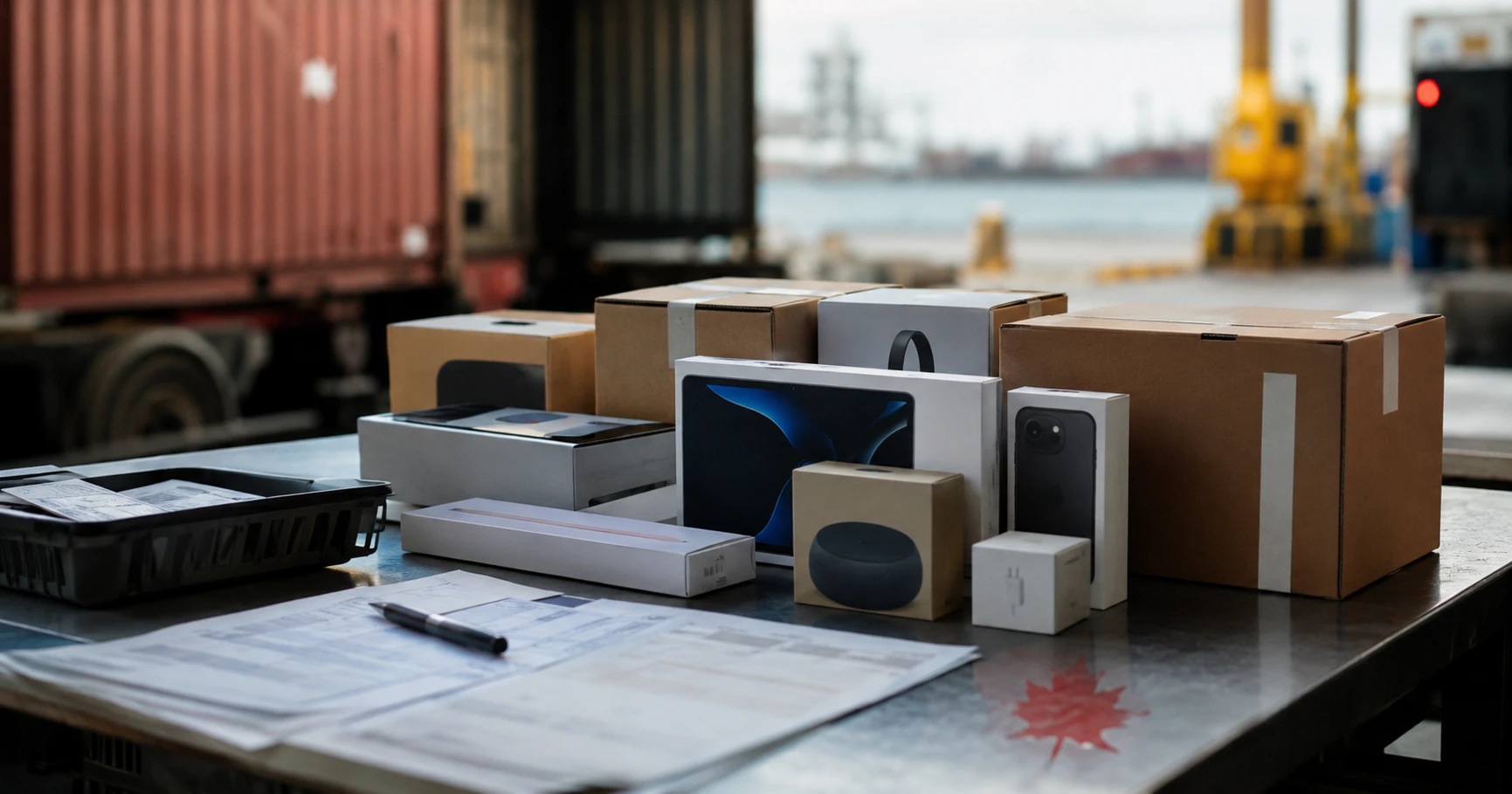
The latest Canada-U.S. tariff fight is moving beyond steel and agriculture and into products much closer to the technology aisle.
New U.S. tariffs of 50 percent on $27.6 billion worth of Canadian goods took effect on August 22 after trade negotiations stalled. Canada has since announced matching counter-tariffs, with electronics among the sectors targeted when the Canadian measures begin on September 8.
That does not mean every laptop, phone or television in Canada is about to become 50 percent more expensive. The actual impact depends on the tariff classification, country of origin, supply chain and whether a product is included in Canada’s final list.
It does mean Canadian tech buyers and businesses should stop treating the dispute as something confined to heavy industry.
What changed on August 22
The United States imposed new 50 percent tariffs on $27.6 billion of Canadian goods effective August 22.
Canada subsequently suspended negotiations rather than accept the U.S. terms and announced a dollar-for-dollar response. According to Finance Canada, Canadian counter-tariffs of 15, 25 and 50 percent will take effect September 8 on products covering $27.6 billion in U.S. imports.
The government specifically lists electronics among the sectors included, alongside steel, dairy, appliances, agricultural equipment, pulp and paper.
The rate is not one blanket percentage for every targeted product. Canada says individual goods will face rates matching the corresponding U.S. tariff.
Why “electronics” does not mean every electronic device
Tariffs are applied through detailed customs classifications, not broad retail categories.
A finished laptop, a semiconductor component, a networking device and an appliance with embedded electronics can all fall under different tariff codes. Some products may be targeted while another device sitting beside them on a store shelf is not.
Country of origin also matters. A phone sold by an American company may be manufactured in Asia and imported directly into Canada, meaning it is not automatically treated as a U.S.-origin product for tariff purposes.
That is why headlines suggesting Canada has placed a 50 percent tax on “American technology” would be misleading.
The correct question is whether the specific product and origin are on the counter-tariff list.
Canadian businesses can still feel the cost before consumers do
Technology supply chains contain many boring components that never appear in retail marketing.
Industrial electronics, control systems, power equipment, server parts, specialized machinery and replacement components can move between Canada and the United States several times before becoming part of a finished project.
If one of those inputs is targeted, Canadian businesses may face higher landed costs even when the final product itself is not directly tariffed.
That matters for data centres, telecom networks, manufacturing plants and energy projects where U.S. suppliers are deeply integrated into procurement.
Price increases are not always equal to the tariff rate
If a product faces a 25 percent tariff, the retail price does not automatically rise by exactly 25 percent.
The importer may absorb part of the cost. The manufacturer may change its wholesale price. A retailer may reduce margin. A company may shift sourcing to another country. Exchange rates and existing inventory can delay the effect.
The reverse is also true. Secondary supply-chain costs can make the eventual price increase larger than the tariff paid on one component.
This is why consumers often see tariff effects arrive unevenly rather than as one synchronized price jump on the day a policy begins.
September 8 is the date Canadian buyers should watch
Canada’s counter-tariffs do not take effect until September 8.
That gives businesses a short window to review inventory, customs classifications and U.S.-origin purchases before the new rates apply.
For ordinary consumers, panic-buying electronics is not justified. Most people do not know whether the product they are considering will be affected, and retailers may already have inventory in Canada that entered under the previous rules.
A better approach is to watch actual Canadian pricing on specific products rather than assuming every American brand will jump at once.
The dispute could push more sourcing away from the U.S.
Tariffs change behaviour as much as they raise revenue.
If a Canadian business can buy a comparable component from Europe, Asia or a domestic supplier without the additional tariff, the U.S. product becomes less competitive even if its original price was lower.
Over time, that can permanently alter supplier relationships.
For Canadian technology policy, there is an obvious lesson. Heavy dependence on one neighbouring market is efficient when trade is frictionless and fragile when trade becomes a political tool.
Domestic manufacturing will not replace every imported semiconductor, router or industrial controller. Diversifying critical supply chains can still reduce exposure to the next policy shock.
The tech angle is bigger than phones and laptops
The most visible consequence of an electronics tariff would be a higher sticker price at Best Buy or the Apple Store. The more important consequences may happen deeper in the economy.
Canadian companies building telecom networks, factories, clean-energy systems, data centres and research infrastructure all buy specialized technology from U.S. suppliers.
If tariffs remain in place long enough, procurement teams will redesign around them.
That makes the August 22 escalation more than another episode in a trade dispute. It is another reminder that technology supply chains are now part of economic-security policy.
For Canadians, the smart move is not to assume every gadget is about to become dramatically more expensive. It is to pay attention to exactly which electronics Canada targets on September 8 and which industries have the least room to switch suppliers.
Tags: Canada Tech, Tariffs, Electronics, trade, Business & Policy