Canada’s Submarine Sank a U.S. Warship. Here Is What Actually Happened.
Matthew Leo · Published July 26, 2026 · News
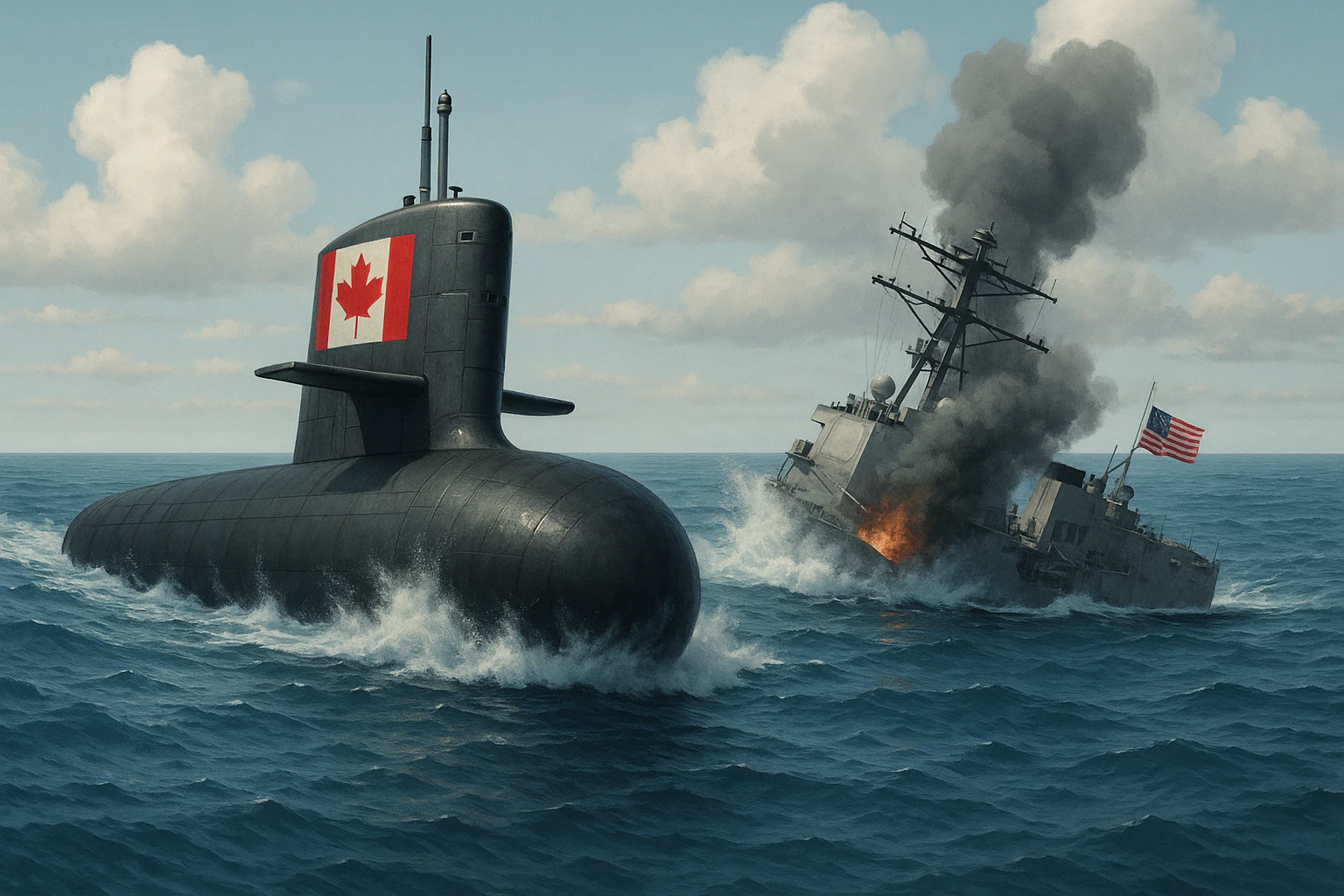
Canada’s Submarine Sank a U.S. Warship. Here Is What Actually Happened.
A Canadian submarine fired on an American warship and helped send it to the bottom of the Pacific Ocean.
That sentence is true.
It is also missing enough context to sound far more alarming than the actual event.
Canada and the United States have not started a naval war. The American ship was no longer in service, nobody was aboard it, and the attack was part of a planned military exercise involving several allied countries.
On July 12, 2026, the Royal Canadian Navy submarine HMCS Corner Brook participated in a live-fire sinking exercise during RIMPAC, the large multinational naval exercise held around Hawaii.
The target was the former USS Mobile Bay, a retired American guided-missile cruiser that had been stripped, cleaned and prepared to be deliberately sunk.
Several aircraft, ships and land-based units attacked the vessel during the exercise. Defence reporting identified a Mk 48 heavyweight torpedo fired by Corner Brook as the strike that caused the ship’s final loss of buoyancy. Official imagery released through the U.S. military shows the cruiser sinking through the Canadian submarine’s periscope.
So yes, a Canadian submarine helped sink an American warship.
But this was not a contest between Canada and the United States.
It was a test of whether allied forces could find, target and destroy a large ship together in realistic conditions.
What Is RIMPAC?
RIMPAC stands for Rim of the Pacific.
Held every two years, it is described by the U.S. Navy as the world’s largest international maritime exercise. The 2026 edition runs from June 24 to July 31 around the Hawaiian Islands and Southern California.
Canada sent more than 800 military personnel, the submarine HMCS Corner Brook, the frigates HMCS Regina and HMCS Ottawa, the support vessel Asterix, aircraft and helicopters.
It was also the first time a Canadian submarine had participated in RIMPAC since HMCS Victoria attended in 2014.
The exercise brings allied countries together to practise operations that would be difficult to reproduce individually. That includes air defence, anti-submarine warfare, amphibious operations, surveillance, logistics and live weapons firing.
RIMPAC is partly about military readiness.
It is also about making sure forces from different countries can communicate, share targeting information and operate together without turning a complicated mission into an expensive international misunderstanding.
The sinking of USS Mobile Bay was one of those tests.
The Ship Was Attacked From Several Directions
The former Mobile Bay was not placed in the ocean for a private duel with the Canadian submarine.
The sinking exercise involved weapons launched from land, aircraft, helicopters, surface forces and below the water.
American and Japanese ground units used anti-ship weapons. Aircraft and helicopters also struck the vessel. The Canadian submarine’s torpedo attacked below the waterline after the ship had already absorbed multiple hits.
That sequence matters because different weapons affect ships differently.
A missile may damage sensors, weapons, communications equipment or structures above the waterline. A heavyweight torpedo attacks the hull beneath the surface, where flooding and structural damage can threaten the entire vessel.
The exercise was therefore not simply testing whether a powerful torpedo could sink an old ship.
It was testing whether several military units from different countries could locate one target, coordinate their attacks and deliver different weapons without interfering with one another.
The U.S. Navy says these exercises allow participating forces to practise tactics, targeting and live firing in conditions that simulators cannot completely reproduce.
A computer model can estimate what a missile or torpedo will do.
It cannot perfectly recreate the sea, weather, communication delays, equipment problems and human decisions that appear during a real operation.
Why Was the USS Mobile Bay Chosen?
USS Mobile Bay was not a disposable barge.
It was a Ticonderoga-class guided-missile cruiser with more than 36 years of service in the United States Navy.
Commissioned in 1987, the ship supported Operation Desert Storm, where it launched 22 Tomahawk missiles. It also participated in Operation Iraqi Freedom, helped evacuate people during the 1991 eruption of Mount Pinatubo in the Philippines and supported several carrier strike groups during its long career.
The cruiser was decommissioned in August 2023.
Retired ships can be preserved as museums, sold, dismantled, recycled or used as targets.
The U.S. Navy selected Mobile Bay for a sinking exercise because a large, real warship provides a far more useful target than a floating platform designed only for training.
Its size, internal compartments and reinforced structure allowed military planners to observe how a former combat vessel responded to several types of weapons.
There is something uncomfortable about watching a ship with decades of history disappear below the ocean.
For former crew members, it may feel less like destroying an old machine and more like watching a former home being demolished.
But from the navy’s perspective, the ship continued serving one final purpose: teaching current forces how modern weapons affect a large vessel.
Do Navies Just Dump Polluted Ships Into the Ocean?
Sinking a former warship raises an obvious environmental question.
These vessels once carried fuel, oil, electrical equipment, plastics, heavy metals and other materials that should not simply be abandoned at sea.
The U.S. Navy says former ships used in sinking exercises are prepared under environmental rules enforced by the Environmental Protection Agency. Petroleum products, rubbish, mercury-containing equipment, certain chemicals and materials that could float away are removed as far as practicable.
The Navy must document the cleaning process, sink the vessel in deep water at least 50 nautical miles from land and survey the area for ships, aircraft, people and marine animals before firing begins.
The Mobile Bay was sunk more than 50 nautical miles north of Kauai in water approximately 15,000 feet deep.
Those precautions reduce the environmental danger.
They do not make sinking thousands of tonnes of metal in the ocean environmentally meaningless.
It is reasonable to question whether every substance can truly be removed and whether military training benefits justify placing another large artificial structure on the seabed.
The Navy’s answer is that realistic live-fire testing is necessary and that the vessels are cleaned under strict rules before being used.
The public is entitled to examine whether those rules are strong enough rather than treating the word “cleaned” as the end of the discussion.
The Torpedo Strike Was a Meaningful Test for Canada
HMCS Corner Brook belongs to Canada’s Victoria class, a group of four conventionally powered submarines acquired from Britain.
The submarine is approximately 70 metres long, displaces about 2,450 tonnes while submerged and carries a crew of roughly 50 people. Canada says the class can remain on patrol for about eight weeks and travel at more than 20 knots underwater.
Unlike a nuclear submarine, Corner Brook relies on diesel generators and batteries. It must periodically approach the surface and use a snorkel to recharge.
That limits its underwater endurance compared with a nuclear-powered attack submarine.
Diesel-electric boats still have important advantages. When moving slowly on battery power, they can be extremely quiet. That makes them valuable for surveillance, gathering intelligence and approaching ships without advertising their position.
A submarine does not need to be the largest or fastest vessel in the ocean to be dangerous.
It needs to detect the other ship before the other ship detects it.
During the RIMPAC exercise, Corner Brook had to take its place inside a larger allied operation, maintain awareness of nearby forces, build a firing solution and launch a live heavyweight torpedo safely.
That is far more significant than simply proving that the torpedo can explode.
It shows that the crew, sensors, communications equipment, weapons and allied targeting process could work together under real conditions.
It Does Not Prove Canada’s Submarine Fleet Is Healthy
This is where the patriotic victory lap should slow down.
One successful torpedo attack does not erase the long problems surrounding Canada’s submarine fleet.
The four Victoria-class submarines were originally built for the British Royal Navy and acquired by Canada in the late 1990s. They have faced lengthy maintenance periods, equipment problems and limited availability during their Canadian service.
Canada is now spending up to $1 billion modernizing the class so it can remain relevant into the mid-to-late 2030s. The programme includes improvements to sensors, survivability, living conditions and other systems.
HMCS Corner Brook itself spent years away from normal operations following a grounding in 2011 and later maintenance and repair work.
Its appearance at RIMPAC is therefore encouraging precisely because Canada has struggled to keep enough submarines available.
The event proves that Canada can still deploy a capable submarine crew and conduct a complex live-fire attack alongside allies.
It does not prove that Canada can maintain enough submarines at sea consistently to cover the Atlantic, Pacific and Arctic.
A fleet of four boats does not mean four are always ready.
Some will be undergoing maintenance. Others may be in training, repair or preparation for deployment.
That is why the number of operational submarines matters more than the number painted on a government fleet list.
Canada Is Planning a Much Larger Fleet
Canada has now selected German shipbuilder TKMS as the preferred supplier for a possible fleet of up to 12 new submarines.
The government says expanding from four submarines to as many as 12 would give the Royal Canadian Navy greater flexibility to maintain vessels, train crews and sustain a presence in several regions at once. The selection does not yet mean Canada has received 12 submarines or signed every final agreement, but it is a major step in the replacement programme.
Canada has said it wants conventionally powered submarines capable of operating under ice. Earlier government planning anticipated awarding a contract by 2028 and receiving the first new vessel no later than 2035.
That timeline leaves little room for delay.
The Victoria-class fleet is expected to reach the end of its service life between the mid-2030s and around 2040. Submarines take years to design, build, test and crew.
Canada cannot wait until the existing boats are ready for retirement before becoming serious about replacing them.
The RIMPAC strike makes the argument for new submarines more clearly than any procurement presentation could.
A submarine can quietly collect information, protect other naval forces and threaten a much larger ship.
The capability is valuable.
The question is whether Canada will maintain enough of it.
Why Canada Needs Submarines
Canada has the world’s longest coastline and maritime approaches in the Atlantic, Pacific and Arctic.
Surface ships and aircraft remain essential, but they cannot replace everything a submarine does.
A submarine can watch an area without making its presence obvious. It can follow ships, gather acoustic information, protect allied forces and force a potential opponent to behave more cautiously simply because a submarine may be nearby.
That uncertainty is part of its value.
A hostile ship that knows no submarine is present can move more freely.
A hostile ship that suspects one may be present must devote time, aircraft, sensors and escorts to finding it.
Canada’s government describes submarines as important tools for surveillance, sovereignty, intelligence, joint targeting and special-forces support.
This matters increasingly in the Arctic, where shrinking sea ice, resource competition and military activity are creating greater pressure on Canada to understand what is happening in its own northern waters.
Sending a submarine to an exercise near Hawaii does not defend the Arctic directly.
It does show that Canada can contribute to allied undersea operations and that its crews can use weapons in a complex environment.
The Viral Headline Is Funny. The Real Story Is Serious.
There is an obvious humour in the headline.
Canada, a country whose military procurement problems are almost a national tradition, showed up at an American-led exercise and sank an American cruiser.
But treating the event as a Canadian victory over the United States misses its purpose.
The countries involved were working together.
The target was retired.
The ship was empty.
The sinking was planned.
The real achievement was not catching the United States by surprise. It was proving that a Canadian submarine could enter a multinational exercise, operate alongside allied forces and successfully complete a live weapons attack.
Canada should take some pride in that.
It should not use the moment to pretend everything is fine.
HMCS Corner Brook demonstrated why submarines remain valuable. Its long journey back to full operations also demonstrated what happens when a country tries to stretch a small, ageing fleet across too many years.
The torpedo worked.
The crew completed the mission.
Now Canada has to prove it can build and sustain the submarine force it says it needs.
A retired American cruiser at the bottom of the Pacific is a striking image.
The more important question is how many Canadian submarines will be ready to sail when the target is not waiting patiently to be sunk.