ChatGPT for Finance Still Needs a Human Approval Layer
Matthew Leo · Published September 13, 2026 · AI
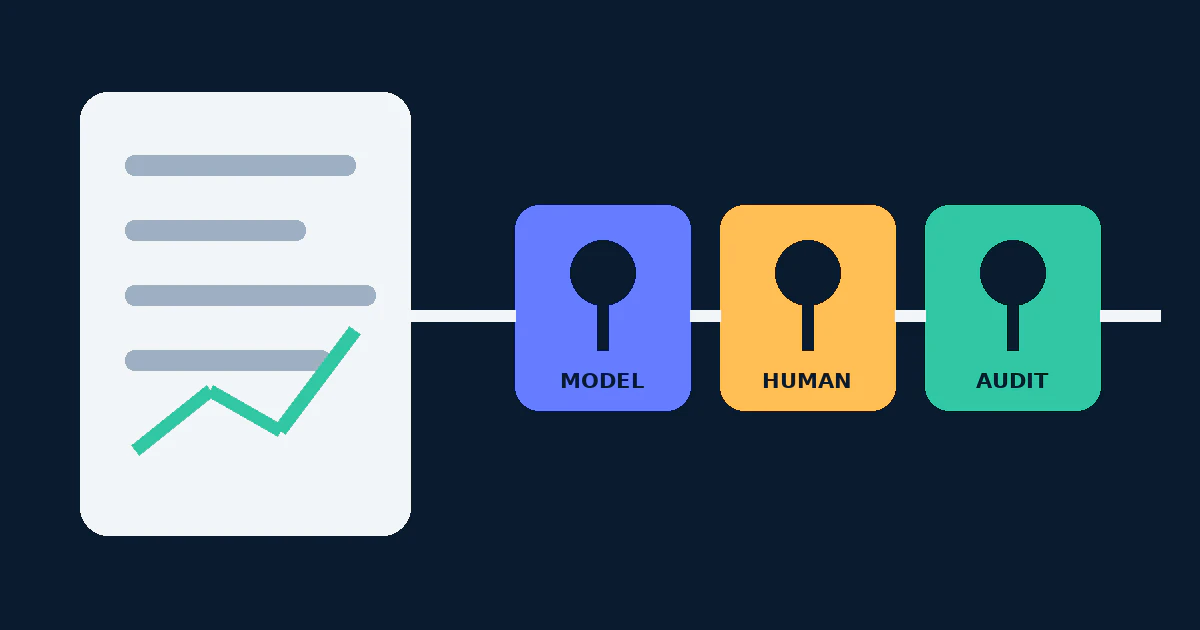
OpenAI has launched ChatGPT for Financial Services, a specialized workspace for investment banking and equity research. It combines GPT-6 Astra with built-in financial datasets and connections to firms’ existing data subscriptions.
The pitch is straightforward: research across several sources, build financial models and draft client materials without stitching together a dozen tools. The risk is equally straightforward. A polished spreadsheet or pitchbook can still contain the wrong source, stale figure, broken formula or conclusion that exceeds the evidence.
For Canadian financial institutions, the useful question is not whether the product has enterprise security features. It is whether every material use has an owner, an approved purpose and a human who can reject the output. That control problem builds on Mapletechie’s earlier analysis of frontier AI as a financial-system cyber risk.
What OpenAI says the product includes
- Model: GPT-6 Astra, which OpenAI says improves retrieval across financial tools, financial reasoning and generated-content accuracy.
- Built-in sources: Daloopa, LSEG News, PitchBook, Crunchbase, Quartr and other datasets covering financial statements, earnings transcripts and company fundamentals.
- Connected subscriptions: Firms can link existing access to services including FactSet, S&P Global, Preqin and Datasite.
- Work products: Research, financial models and client materials can use a firm’s own templates.
- Administrative controls: OpenAI cites role-based access, encryption and exports of workspace logs into audit workflows.
Morgan Stanley and Evercore helped shape the product as design partners. That provides useful industry input, but it is not independent proof that every workflow, dataset or calculation is reliable.
Connected data does not settle permission questions
One interface can search many sources only if the user is entitled to see each source and use it for that purpose. A subscription connection should preserve document-level permissions, information barriers and licensing restrictions. A person who cannot open a confidential deal-room file directly should not receive its contents through a generated summary.
Firms also need to distinguish retrieval from truth. A citation can show where a statement came from; it does not prove that the source was current, interpreted correctly or appropriate for the calculation. Draft output should preserve the exact source, date, currency, units and accounting period behind every material number.
The spreadsheet is where confidence can become expensive
Financial models fail in ordinary ways: a sign flips, a range omits a row, a percentage is applied to the wrong base or a figure expressed in thousands is treated as millions. Generative systems add another failure mode by producing a plausible structure when the evidence is incomplete.
A defensible workflow separates assistance from approval:
- Define the permitted task. Drafting a comparable-company list is not the same risk as recommending a trade or setting a credit decision.
- Lock the source set. Record which documents, datasets and versions the model may use.
- Recalculate material figures. A human or deterministic tool should reproduce totals, ratios and formulas independently.
- Review the narrative. Confirm that caveats, contrary evidence and jurisdictional limits survived the summary.
- Approve before distribution. Client materials, regulatory filings and investment recommendations need a named accountable reviewer.
Canada’s model-risk rules are broader than one vendor
OSFI’s Guideline E-23 takes effect on May 1, 2027 for federally regulated financial institutions. It treats AI and machine-learning systems as models when they process inputs into useful outputs. The guideline expects institutions to identify models, rate their risk, document approved uses and limitations, review third-party components, monitor performance and maintain contingency plans.
That means a bank cannot outsource accountability to OpenAI, a market-data provider or an impressive benchmark. The institution needs an inventory entry, responsible owners, validation proportionate to the use and evidence that the production configuration behaves as expected. A low-risk research assistant and an automated customer decision should not share the same approval threshold.
What is still unknown
OpenAI has not publicly supplied independent error rates for every financial workflow, pricing in the launch report or evidence that Canadian data entitlements and retention requirements are handled identically across every integration. Availability for a particular Canadian firm will also depend on its contracts, security review and regulatory obligations.
The product’s real advantage may be consolidation: fewer manual handoffs between research, modelling and document creation. Consolidation also concentrates access and mistakes. The safest deployment makes the workspace easier to use while keeping permissions narrow, calculations reproducible and the final decision unmistakably human.
Sources: Reuters’ September 10 launch report and OSFI’s Guideline E-23 on model risk management.
Tags: OpenAI, financial services, GPT-6 Astra, OSFI, model risk