Check an Imported Phone Before Using It in Canada
Matthew Leo · Published August 12, 2026 · Guides
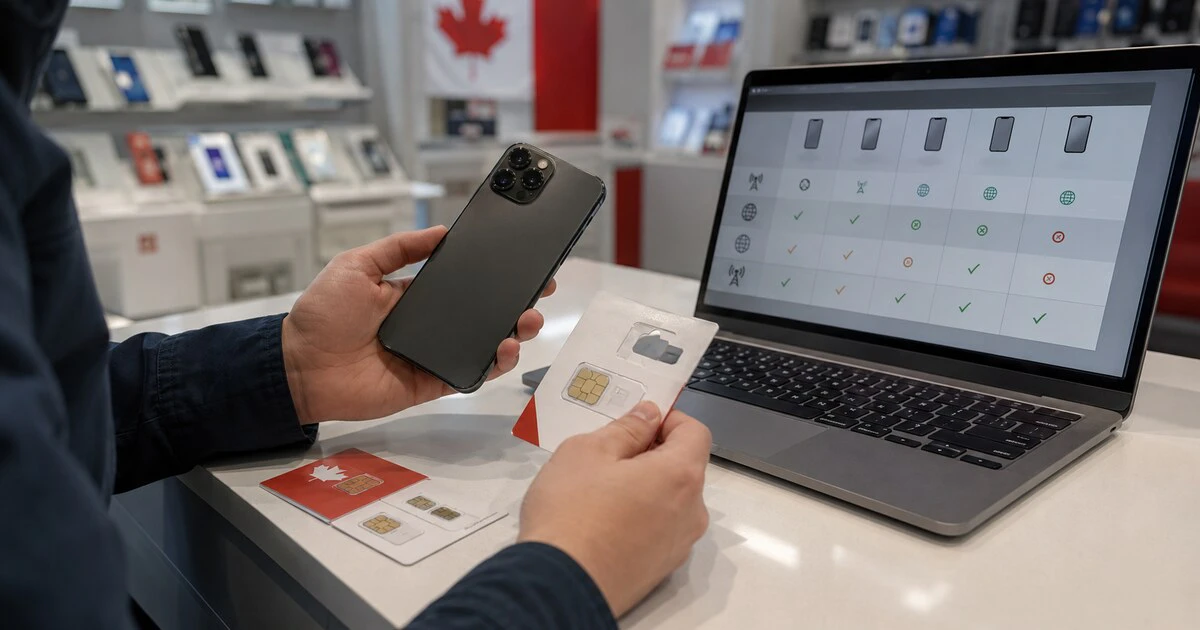
An imported phone can show a Canadian 5G icon and still be a poor Canadian phone.
Data may work while voice calls fall back incorrectly, Wi-Fi Calling remains unavailable or eSIM activation fails. The model name on the listing is not enough because manufacturers sell regional variants with different radios, software and carrier approvals.
Before paying, obtain the exact model number and IMEI. Check both against the carrier you plan to use, then test an ordinary call, mobile data, text messaging and 911 capability without actually placing a test emergency call.
Start with the exact regional model
“Galaxy,” “Pixel,” “iPhone” or “OnePlus” identifies a product family, not necessarily the radio inside it. The seller should provide the complete model code from Settings, the box or the manufacturer’s regulatory page.
Compare that code with the Canadian version. Look for differences in supported LTE and 5G bands, physical SIM slots, eSIM, satellite features and software-update channels. A specification copied from another country’s product page may describe hardware the listing does not contain.
Do not rely on “factory unlocked” as proof of compatibility. Unlocked means the phone is not restricted to one carrier. It does not guarantee that the carrier supports its bands, voice system or advanced services.
Use the carrier’s IMEI checker
The IMEI is the phone’s 15-digit network identifier. Dial *#06# on many phones or find it in Settings. Dual-SIM devices may show two IMEIs.
Bell provides an IMEI compatibility checker and warns that it cannot guarantee compatibility for devices bought internationally. TELUS also directs customers to an IMEI check as Canada’s older networks are retired.
An accepted IMEI is stronger evidence than a seller saying “works in Canada,” but it is not a complete warranty. Check the carrier’s current device policy and keep a screenshot of the result before ordering.
Confirm VoLTE, not only LTE data
Voice over LTE, or VoLTE, carries calls on the LTE network. It matters increasingly as carriers retire older 2G and 3G systems.
Bell says a compatible device needs supported network bands and VoLTE. TELUS says incompatible 3G devices will lose calls, texts and data after its March 1, 2027 shutdown, including the ability to reach 911 through that service.
A phone can support VoLTE technically while a carrier refuses to enable it for that regional firmware or IMEI. Ask the carrier whether the exact model is provisioned, then make a normal voice call with Wi-Fi turned off. Watch whether the network remains on LTE or 5G and whether incoming calls work while data is active.
Do not place a test call to 911. If emergency calling is a concern, ask the carrier how the model is supported and return the phone within the seller’s window when the answer is unclear.
Wi-Fi Calling can be restricted
Wi-Fi Calling routes ordinary carrier calls and texts through an Internet connection when cellular coverage is weak. It requires support from the phone, firmware and carrier account.
Rogers warns that grey-market phones may work for 4G or 5G data while VoLTE or Wi-Fi Calling does not. That is important for Canadians in basements, rural homes and large buildings where indoor coverage is poor.
If Wi-Fi Calling is essential, treat a seller’s promise as unverified until the feature activates on your account. A menu toggle alone does not prove registration completed.
Check bands for the places you use the phone
A phone does not need every Canadian band to connect, but missing an important low-frequency band can reduce rural and indoor coverage. A device may perform well downtown and struggle on highways or inside concrete buildings.
Compare the manufacturer’s official band list for the exact model with the carrier’s published network bands. Be cautious with third-party databases that merge several regional variants into one page.
5G support also has layers. A phone may support one Canadian 5G band but miss another used for wider coverage or higher capacity. The icon does not measure the quality of that match.
Verify SIM, eSIM and software support
Some imported models have two physical SIM slots; others are eSIM-only or restrict eSIM by region. Bell notes that eSIM compatibility can vary on models purchased outside Canada.
Check whether the Canadian carrier will issue an eSIM to that IMEI and whether the phone can download the profile. If travelling or using two lines, confirm the specific dual-SIM combination the model supports.
Regional firmware can also affect update timing, language features, call recording, wallet services and emergency alerts. Ask which country controls the update channel. A phone that receives security patches late is not a bargain simply because its processor is fast.
Check blacklist and ownership status
For a used imported phone, enter the IMEI at DeviceCheck Canada. A device reported lost or stolen can be blocked on participating Canadian networks.
A clean result reduces risk but does not prove the phone is paid off or safe. DeviceCheck says a new report can take time to appear, and some carrier-specific billing blocks may not appear on the national list.
Mapletechie’s used-phone buying checklist covers account locks, proof of purchase, battery condition and safe handover steps.
Warranty and returns may be regional
Manufacturers can limit warranty service to the country or region where a phone was sold. Canadian service centres may not stock the required parts, even when the model looks identical.
Get the warranty terms in writing and identify who pays return shipping. Marketplace “seller warranty” often means sending the phone back to the merchant rather than receiving manufacturer service in Canada.
Pay with a method that offers documented buyer protection. Avoid a seller that will not disclose the model code or IMEI before the return period closes.
Run the full test before keeping it
- Confirm the exact model and IMEI with the carrier.
- Make and receive an ordinary call with Wi-Fi off.
- Send and receive SMS messages.
- Test mobile data in more than one location.
- Activate Wi-Fi Calling if you depend on it.
- Install an eSIM if that feature matters.
- Check software-update and warranty status.
- Verify the IMEI through DeviceCheck for a used phone.
An imported phone can be excellent value when its regional hardware and software match Canadian networks. The costly mistake is checking only whether it gets bars. Compatibility means the services behind those bars still work when you need them.
Tags: imported phones, Canadian carriers, VoLTE, IMEI, smartphones