CoreWeave’s Spending Tests Canada’s AI Sovereignty
Matthew Leo · Published August 12, 2026 · Business & Policy
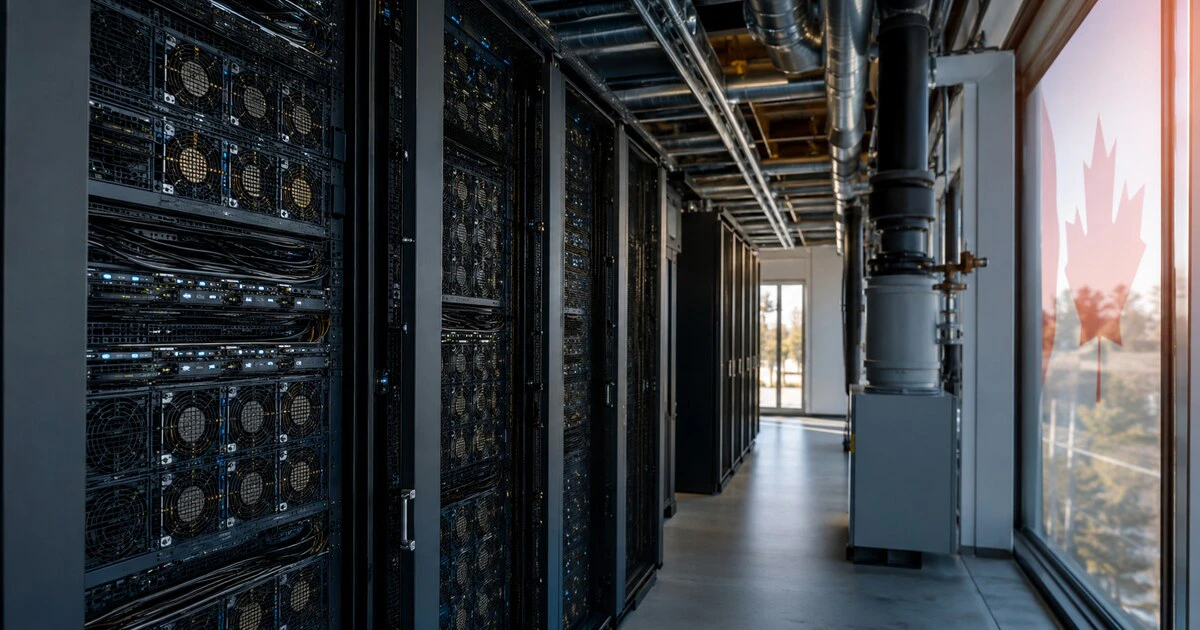
CoreWeave now expects to spend as much as US$39 billion this year building AI infrastructure. That scale helps explain why Canada needs private partners to expand domestic computing capacity. It also shows why calling a data centre “sovereign” cannot depend on its postal code alone.
The American cloud company reported stronger-than-expected second-quarter results on August 11. Revenue more than doubled to US$2.58 billion, while its contracted backlog reached US$104.2 billion. CoreWeave raised its 2026 capital-spending forecast from US$31–35 billion to US$35–39 billion.
Those figures are not just an earnings story. CoreWeave is part of Canada’s effort to give domestic companies access to high-performance computing, including infrastructure connected to Toronto-based Cohere. Canada therefore has a direct policy interest in understanding what the company’s rapid growth does and does not deliver.
The demand is real, and so is the concentration
Reuters reported that CoreWeave’s near-term capacity is effectively sold out. The company secured more than US$25 billion in additional customer commitments early in the current quarter, on top of its backlog.
CoreWeave’s business is straightforward at a high level: acquire large numbers of advanced processors, install them in data centres and rent the capacity to customers building or operating AI systems. The difficulty lies in financing equipment that becomes obsolete quickly, securing enough power and cooling, and keeping expensive facilities busy for years.
For customers, the appeal is access. A Canadian company does not have to raise billions of dollars and wait for a new campus before training or serving a model. It can rent capacity from a specialist that has already assembled the hardware and software.
The trade-off is dependence. A small number of cloud providers, chip suppliers and major customers can end up controlling the route to advanced computing. Domestic location reduces some risks, but it does not automatically create Canadian control over pricing, maintenance, software, financing or business continuity.
Canada has already put public money behind compute
The federal government announced up to C$240 million for Cohere in 2024 as the first investment under its C$2-billion Canadian Sovereign AI Compute Strategy. The money was intended to help attract private capital for a multi-billion-dollar Canadian data centre and expand domestic computing capacity.
Finance Canada divided the strategy into three parts: up to C$700 million to mobilize private data-centre investment, up to C$1 billion for public supercomputing infrastructure and up to C$300 million to improve access for Canadian innovators.
That mix is sensible. Commercial clouds can build quickly and serve business demand. Public infrastructure can support research and projects that do not fit a cloud provider’s margins. An access fund can help smaller firms that need computing power but cannot negotiate like a multinational customer.
The word “sovereign” still needs a measurable definition. Otherwise, it risks becoming a flattering label for equipment physically installed in Canada but controlled through contracts and dependencies elsewhere.
What Canadian sovereignty should require
| Question | What a useful answer should show |
|---|---|
| Where is the data processed? | The location of storage, backups, logs and model outputs—not only the server rack. |
| Who can access it? | The legal entities, subcontractors and support teams with technical or contractual access. |
| Which law applies? | How Canadian obligations interact with foreign court orders and corporate ownership. |
| Can a customer leave? | Portable data, models and workloads without punitive exit costs or proprietary lock-in. |
| What happens during failure? | Continuity plans for outages, insolvency, sanctions, supply shortages or a contract dispute. |
| Who benefits publicly? | Canadian jobs, research access, tax revenue, energy commitments and enforceable service terms. |
None of these tests requires excluding foreign companies. Canada’s computing needs are too large and urgent for an isolationist plan. The point is to build bargaining power and resilience rather than replace one slogan with another.
Growth makes contract details more important
CoreWeave spent US$9.4 billion on capital projects in the second quarter, up from US$6.8 billion in the previous three months. Its success depends on sustained customer demand and continued access to equipment, debt and electricity.
A public agency or publicly supported Canadian company should therefore ask what happens if delivery is late, prices change or a facility cannot obtain the power it expected. Capacity reservations, performance guarantees and termination rights matter more than a launch-day photograph of new servers.
Canada should also avoid tying all important domestic workloads to one architecture. A credible strategy needs more than one commercial supplier, usable public infrastructure and software that can move between environments. Redundancy costs money, but so does discovering that a “sovereign” system has only one practical operator.
Domestic compute is necessary but not sufficient
CoreWeave’s results confirm that demand for AI infrastructure remains enormous. Its spending can help Canada obtain capacity faster than a government-only build and give Canadian companies access to equipment they could not purchase independently.
That is useful infrastructure. Sovereignty begins when Canada can state what is controlled here, audit the promise and keep essential work running when a provider’s incentives change.
The racks can be in Cambridge, Toronto or anywhere else in the country. The harder question is whether Canadian customers and institutions retain meaningful choices after the cables are connected.
Tags: CoreWeave, AI infrastructure, Canadian technology, data centres, digital sovereignty