Canada Needs Better Data-Centre Water Disclosure
Matthew Leo · Published August 6, 2026 · Business & Policy
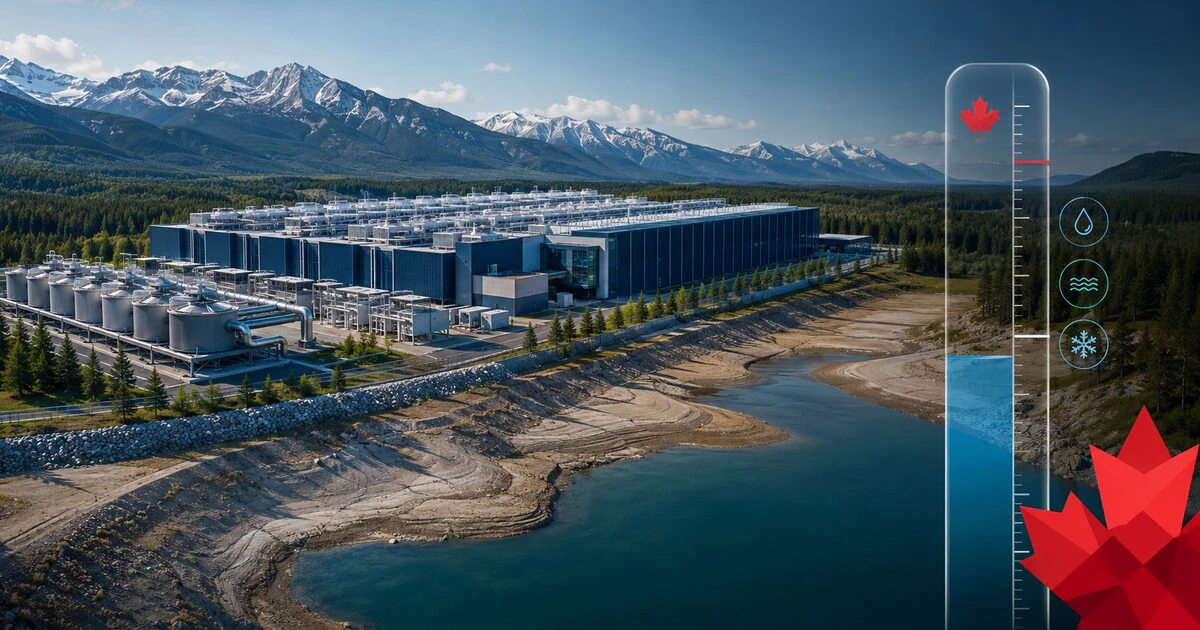
A data centre should not receive years of guaranteed water before the public learns how much it will need during a drought.
That concern is driving opposition to Google’s planned US$15-billion data-centre project in Visakhapatnam, India. The dispute is happening thousands of kilometres from Canada, but its central questions are already relevant here: which water source will serve a large computing facility, who receives priority during shortages and how much public infrastructure must be built around it?
Canada is actively pursuing AI infrastructure, particularly in Alberta. Governments should welcome serious investment without treating cooling claims as a substitute for public, project-specific numbers.
Google’s Indian project has become a water dispute
Reuters reported on August 6 that environmental groups and residents are challenging the Visakhapatnam project over its possible effects on local water supplies and the nearby Kambalakonda Wildlife Sanctuary.
The challengers allege that a large water commitment could worsen existing shortages. The Andhra Pradesh government denies that residential or rural drinking-water sources will be diverted and says legitimate environmental concerns will be addressed. Google says the project will use advanced air cooling and comply with applicable requirements.
Those positions must remain attached to their owners. The court has not resolved the dispute, and a promise to use air cooling does not by itself reveal the facility’s complete water demand. Data centres can consume water directly through cooling and indirectly through the electricity that powers them.
Canada is building its own large projects
Alberta has made data centres a major economic priority. Its strategy is built around power capacity, sustainable cooling and economic growth, while companies are proposing facilities measured in hundreds of megawatts.
Meta announced a C$13-billion Alberta data centre in July. Reuters reported that the first phase is designed for one gigawatt and could eventually reach 1.8 gigawatts. Meta says it will use water-efficient cooling and finance new power infrastructure.
Alberta’s current guidance acknowledges that approvals depend on project-specific water requirements. It also says the province’s 2026 Water Amendment Act contains no provisions written specifically for data centres.
That does not mean the projects operate outside water law. It means the ordinary approval system must evaluate unusually large and fast-changing facilities without a dedicated public disclosure template.
Annual consumption is not enough
A company can publish an annual water estimate that conceals the period when demand matters most. Communities need to know how the facility behaves on the hottest, driest days—not only its average across a Canadian winter.
| Information to disclose | Why the public needs it |
|---|---|
| Water source | Municipal drinking water, groundwater and reclaimed wastewater create different risks. |
| Average and peak demand | A yearly total can conceal intense summer use. |
| Cooling technology | Air, evaporative and hybrid systems have different energy and water trade-offs. |
| Drought response | Residents should know which uses are reduced first during a shortage. |
| Indirect consumption | Electricity generation may carry an additional water burden elsewhere. |
| Public infrastructure | Pipelines, treatment capacity and utility upgrades can shift costs to the community. |
The disclosure should also identify who verified the estimate. A figure prepared for a marketing presentation is not equivalent to a permit condition backed by monitoring and enforcement.
“Water efficient” needs a denominator
Efficiency describes water used per unit of computing, energy or another output. A facility can become more efficient while its total consumption rises because the campus becomes much larger.
Projects should therefore publish both efficiency and absolute demand. The public needs to know whether a cooling design uses less water for each unit of computing and whether the completed facility will consume more water overall.
Comparisons also need consistent boundaries. One company may report only water consumed inside the data centre, while another includes electricity generation, construction or restored watersheds. All can produce impressive-looking numbers that describe different things.
Fast approvals still need public evidence
Alberta plans a 120-day decision period for qualifying major projects beginning in fall 2026. A predictable timeline can reduce uncertainty without weakening review, but only if companies provide complete information early enough for regulators and communities to examine it.
A regulatory clock should pause when a proponent has not supplied reliable water, power or environmental data. Speed is useful when it eliminates administrative drift; it becomes dangerous when missing evidence is treated as approval by exhaustion.
Federal participation also varies. In April, the Impact Assessment Agency of Canada determined that potential adverse federal effects from one Alberta data-centre project would be limited or addressed through other mechanisms. That decision did not declare every future data centre environmentally minor.
Make water performance visible after construction
Forecasts should become enforceable operating records. Large facilities should report actual monthly withdrawals, peak demand, reclaimed-water use and any periods when limits were exceeded.
Public reporting would reveal whether the original design worked. It would also help other municipalities compare proposals instead of relying on unrelated facilities built in different climates.
Canada has real advantages for computing infrastructure, including a cool climate, skilled workers and substantial energy resources. Those advantages do not remove local constraints.
The lesson from Google’s dispute is not that Canada should reject AI data centres. It is that a government should settle the water questions before promising that a project and its neighbours can comfortably drink from the same source.
Tags: data centres, water, artificial intelligence, Alberta, infrastructure