Gemini 3.8 Flash Keeps Token Prices Flat, Not Task Costs
Matthew Leo · Published September 5, 2026 · AI
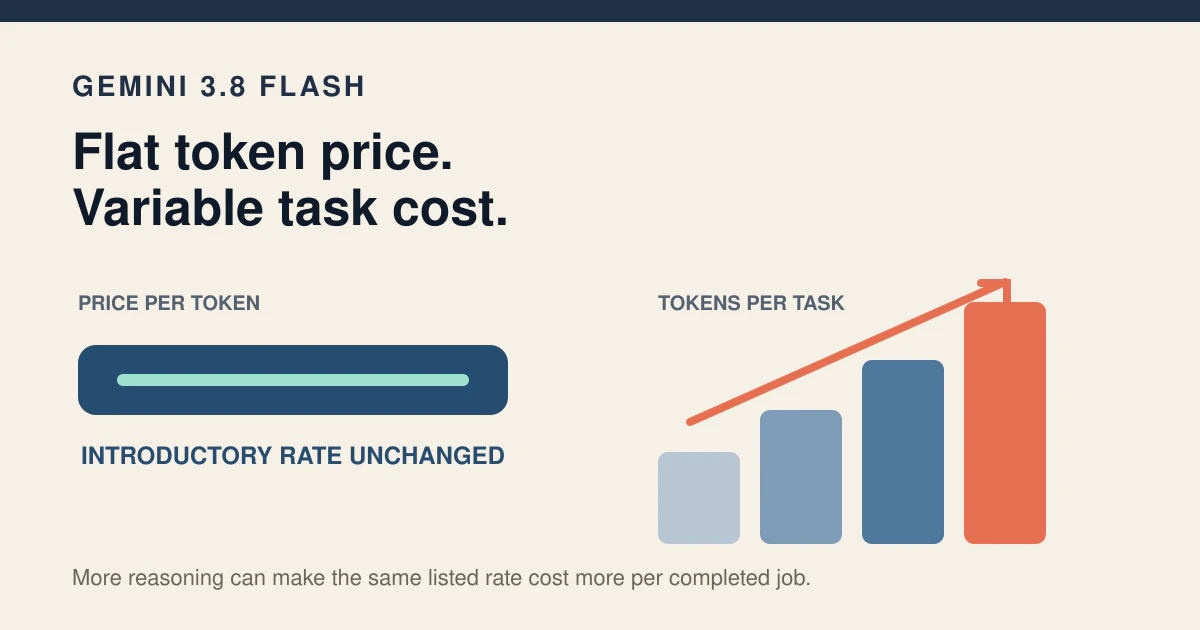
Google launched Gemini 3.8 Flash on September 2 with the same introductory per-token rates as Gemini 3.7 Flash: $0.75 per million input tokens and $3.75 per million output tokens.
That does not mean an application will spend the same amount to finish the same job.
Google says the new model “works harder” on complex tasks by taking extra reasoning steps and calling tools repeatedly. It also warns that higher effort can use more tokens. The useful unit for a developer is therefore not price per token. It is cost per successful task.
The listed price stays flat until December 31
According to Google’s launch announcement, Gemini 3.8 Flash uses the same introductory rate as 3.7 Flash. That rate expires December 31, 2026. On January 1, 2027, Google says pricing will rise to $1.50 per million input tokens and $7.50 per million output tokens.
Through December 31, 2026
Input: US$0.75 per million tokens
Output: US$3.75 per million tokens
From January 1, 2027
Input: US$1.50 per million tokens
Output: US$7.50 per million tokens
These are Google’s listed dollar prices. Canadian teams should also account for billing currency, exchange rates and any cloud-contract terms that apply to their account.
More reasoning changes the invoice
A simple illustration shows why the token rate is only half the story. At the introductory price, a task using 100,000 input tokens and 20,000 output tokens costs about $0.15. If the same input produces 40,000 output tokens because the model reasons longer or makes more tool calls, the task costs about $0.225.
Those are illustrative calculations, not measured Gemini 3.8 usage. Real cost depends on the application, caching, context, tool loop, retries and the effort setting.
A model can still be better value while costing more per run. If it finishes a job that the cheaper model fails twice, the higher first-pass cost may save money. Conversely, better benchmark results do not help a workload that already succeeds with a smaller token budget.
Run an evaluation that resembles production
Before replacing 3.7 Flash, test both models on a fixed set of real tasks. Record:
input, output and any billable reasoning tokens;
tool calls and retries;
time to a usable answer;
successful completions without human repair;
cost per accepted result;
failure modes that could create risk or extra review work.
Use the same prompts, tools, timeouts and acceptance rules for both models. A hand-picked demo is excellent at demonstrating that a demo was hand-picked.
Google says lower effort levels can reduce token overhead, and it continues to support Gemini 3.7 Flash for efficiency-first workloads. That makes routing more sensible than a blanket upgrade: send difficult jobs to 3.8 and leave predictable, low-value work on the cheaper path after testing.
Flash Cyber is not the public model
Google also announced Gemini 3.8 Flash Cyber, a security-focused version for vulnerability discovery and automated patching. Access is restricted through the Fairwind Program to vetted governments, critical-infrastructure operators, software maintainers and other trusted defenders.
Public Gemini 3.8 Flash and restricted Flash Cyber share underlying intelligence, but they are not interchangeable products. A normal Gemini subscription or API key does not provide the more permissive cyber model.
Google reports strong results for both models, including gains in software-engineering and professional-agent benchmarks. Those numbers remain vendor claims until reproduced under independent conditions, and a benchmark score cannot predict the exact cost or reliability of one company’s workflow.
What this means in Canada
Gemini 3.8 Flash is available to developers through the Gemini API and to Google AI Pro and Ultra subscribers in consumer products. Google lists Canada among supported Gemini mobile-app markets.
Canadian organizations handling regulated, confidential or client data still need to review their plan’s data terms, logging, residency requirements and access controls before routing production work to a new model. Faster model turnover makes that governance work more frequent, not less important.
The broader AI market is increasingly selling capability by benchmark and price per million tokens. Mapletechie’s analysis of Nvidia’s AGI claim makes the related point: labels are weak substitutes for a defined test.
For Gemini 3.8 Flash, the best test is straightforward. Measure the complete job, not the attractive number beside one million tokens.
Tags: Gemini, Google DeepMind, AI pricing, AI agents, cybersecurity