Humanoid Robot Sales Are Still Tiny Beside the Hype
Matthew Mbaka · September 22, 2026 · AI
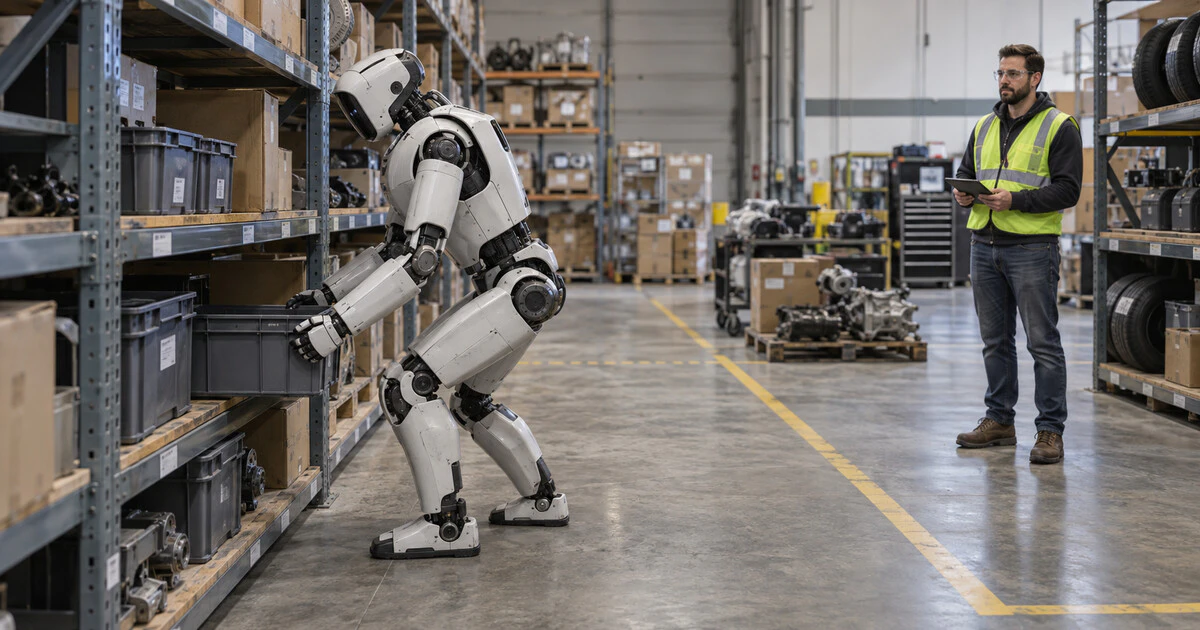
Humanoid robots can run, dance and move boxes in carefully staged demonstrations. The first broad sales tally suggests very few are doing ordinary paid work.
About 7,000 humanoid robots were sold worldwide in 2025 for industrial and professional service use, according to figures compiled by the International Federation of Robotics and reviewed by Reuters. This is the first time the federation has collected humanoid data alongside its larger industrial and service robot counts.
Many of those machines went to research institutions or companies gathering data to improve robotics software. Automakers are running pilots, but the IFR said individual plants often have only single-digit or double-digit numbers.
That is a real market. It is not mass adoption.
Seven thousand needs context
The IFR defines a humanoid as an autonomous robot with a human-like appearance that can operate in an environment designed for people. It does not need legs. The 2025 tally excludes consumer and military humanoids, while medical robots are counted separately.
For scale, factories installed 542,000 conventional industrial robots in 2024. Another estimated 199,000 professional service robots were sold that year for work including transport, hospitality and cleaning.
Those figures cover different categories and years, so they are not a market-share calculation. They do show how far proven automation extends beyond the humanoid format.
The IFR's 2025 industrial report also counted 3,800 industrial robot installations in Canada during 2024. Nearly half served the automotive sector. One year's Canadian installations of established robots were therefore more than half the size of the following year's global humanoid tally.
A robot sale is not the same as a worker replaced
A laboratory that buys a humanoid to gather training data counts as a sale. So does a manufacturer running a short pilot. Neither proves the machine completed a full shift, saved money or remained reliable around people.
That gap is easy to miss when a polished video shows one successful attempt. A buyer needs less glamorous information: intervention frequency, uptime, battery swaps, safe payload, task speed, error recovery and how the robot behaves when a shelf, floor or object is not exactly where training expected it to be.
The human shape can be useful because warehouses and factories were built for human reach, tools and aisles. It can also add complexity. A wheeled base or fixed robot arm may do a narrow job more reliably and at lower cost.
Investment has moved faster than deployment
Bank of America Global Research expects humanoid shipments to reach 90,000 in 2026 and 1.2 million in 2030. Those are forecasts, not orders already placed. Reaching them would require large improvements in production, reliability, service and customer demand.
A separate Reuters report says Chinese regulators are informally raising scrutiny of humanoid robot listings, particularly when valuations rely on revenue from state-backed projects. China's securities regulator did not confirm a formal freeze, so the reported slowdown should not be described as an announced ban.
The concern is still useful. An order from a government-supported training centre can produce revenue without proving that independent customers will pay for the same robot. Investors and buyers need to separate demonstration funding from repeat commercial demand.
What Canadian buyers should ask
A Canadian manufacturer considering a humanoid pilot should ask for evidence from the exact task and environment it plans to use:
- How many units are in paid production work rather than research?
- How long can the robot operate between human interventions?
- What happens when it drops an object, loses balance or loses connectivity?
- Who services it in Canada, and how long do replacement parts take?
- Does the quoted price include integration, safety systems, training and support?
- Can a simpler arm, mobile robot or conveyor solve the same problem?
Labour impact should also be measured against the work actually performed. A pilot that needs two technicians and frequent remote help may build useful knowledge, but it is not yet a one-for-one replacement for a production employee.
Watch deployment, not demonstrations
Seven thousand units is enough to create better machines and meaningful pilots. It is too small to support claims that humanoids have already transformed work.
The numbers worth watching next are repeat orders, paid production deployments, uptime and cost per completed task. Those measures are harder to film than a robot boxing or dancing. They will tell us much more about whether the market is real.
Sources: Reuters on the IFR humanoid tally; International Federation of Robotics; Reuters on reported IPO scrutiny.
Tags: humanoid robots, robotics, automation, manufacturing, China