The Iran War Is Rewriting America’s War-Tech Shopping List
Matthew Mbaka · September 18, 2026 · Business & Policy
The Iran war is changing what the United States means when it talks about advanced military technology.
For years, the sales pitch was usually about range, stealth, precision and a better sensor. Those still matter. But a long war also asks less glamorous questions: How many weapons are on the shelf? How quickly can a factory replace them? Can a $20,000 drone force the defender to fire a multimillion-dollar interceptor?
Those questions are now shaping the Pentagon's shopping list.
The stockpile became part of the technology story
In August, Reuters reported that the US Army had used up much of its global stock of ATACMS and Precision Strike Missiles during five months of war. The exact remaining inventory was not made public, but two sources described the supply as virtually exhausted.
These are not old shells that can be replaced by simply running a line for another shift. Long-range precision weapons contain specialised electronics, propulsion, guidance systems and components supplied by several companies. A design can be excellent and still become strategically weak if production cannot keep pace with use.
The same pressure shows up on defence. Patriot and THAAD interceptors have protected troops, cities and infrastructure from missiles and drones. Their performance matters. So does the rate at which they are fired and replaced.
A military that wins each individual interception can still lose the production contest.
Cheap drones changed the cost calculation
Iran's use of relatively cheap drones did not make high-end air defence obsolete. A cheap attacker can still destroy something enormously valuable, so commanders may have good reason to fire an expensive interceptor.
The problem is doing that repeatedly.
The war has strengthened the case for a layered defence. The most dangerous missiles may still require Patriot or THAAD. Slower drones can sometimes be handled by electronic warfare, guns, small interceptor drones or other lower-cost systems. The goal is not to replace one shield with a bargain version. It is to avoid using the most expensive tool on every target.
That changes which technologies become attractive. Counter-drone sensors need to distinguish a real threat from clutter. Electronic-warfare systems need frequent software updates as signals change. Interceptor drones need to be cheap enough to buy in large numbers and reliable enough to trust near friendly forces.
Artificial intelligence may help with sensor fusion, target classification and route planning. It does not fix bad inventory math. A clever model cannot manufacture a motor, restore an empty launcher or guarantee that an autonomous system will behave correctly in a crowded battlespace.
Factories are becoming a capability of their own
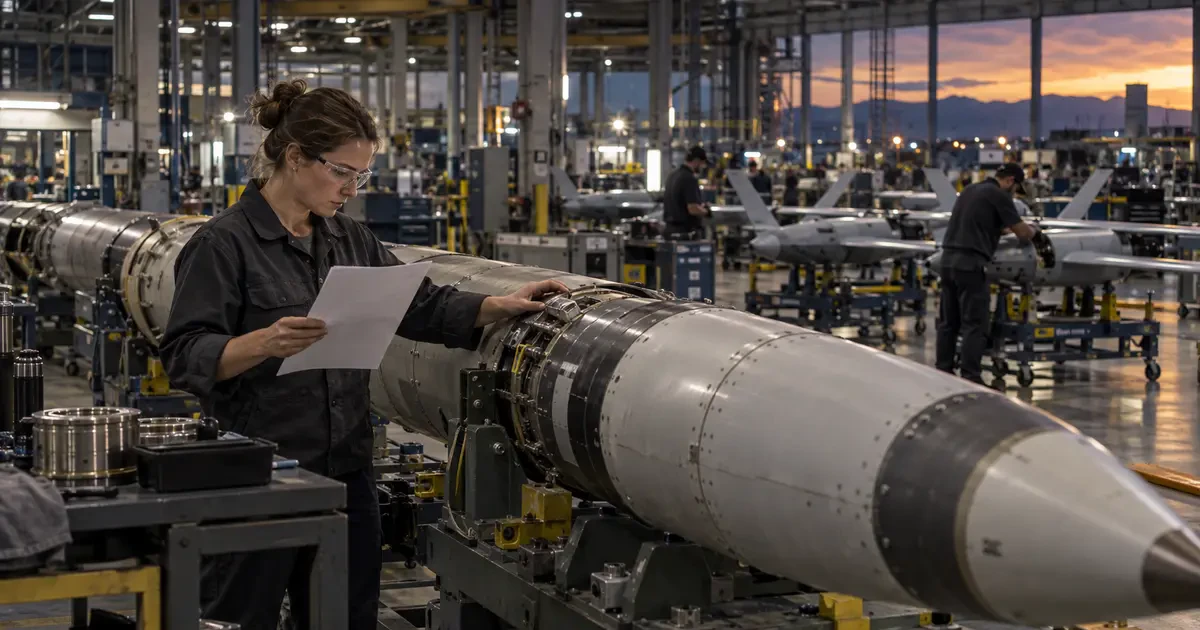
The Pentagon's response is not limited to buying a better missile. It is trying to build a wider production base.
On September 17, Reuters reported that Lockheed Martin had received its first Patriot interceptor components from General Motors Defense only 22 days after their manufacturing agreement was signed. Lockheed says it is investing billions of dollars to expand production across several missile programs.
That partnership matters because the American automotive industry knows how to qualify suppliers, manage complex production and produce at scale. Defence manufacturing has different tolerances and security requirements, but the basic lesson is clear: industrial capacity is no longer background infrastructure. It is part of the weapon system.
A missile that takes years to replenish creates a vulnerability far beyond the current war. A May analysis reported by Defense News estimated that some US inventories could take until 2030 or 2031 to return to prewar levels.
What the Pentagon is likely to value next
Future programs will still compete on range and performance. They will also face harder questions about scale.
- Cost per engagement: What does it cost to defeat the target, not merely to buy the launcher?
- Shots available per day: Can the system handle a sustained attack rather than a short demonstration?
- Production ramp time: How quickly can suppliers increase output without lowering reliability?
- Component resilience: Are motors, chips, seekers and rare materials dependent on one factory or foreign supplier?
- Software adaptability: Can sensors and electronic-warfare tools be updated as the threat changes?
This is a shift from treating exquisite technology as the whole answer. The US still wants weapons that can reach farther and hit precisely. The Iran war is showing that it also needs enough of them, cheaper layers beneath them and factories able to keep going when a conflict lasts longer than the opening plan.
That lesson matters to Canada and other US allies too. They buy from many of the same production lines. When American inventories tighten, allied delivery schedules and replacement plans can tighten with them.
Tags: Iran war, military technology, Pentagon, drones, defence industry