Apple’s M6 Mac mini Starts at $1,249 in Canada
Matthew Leo · Published August 29, 2026 · Gadgets
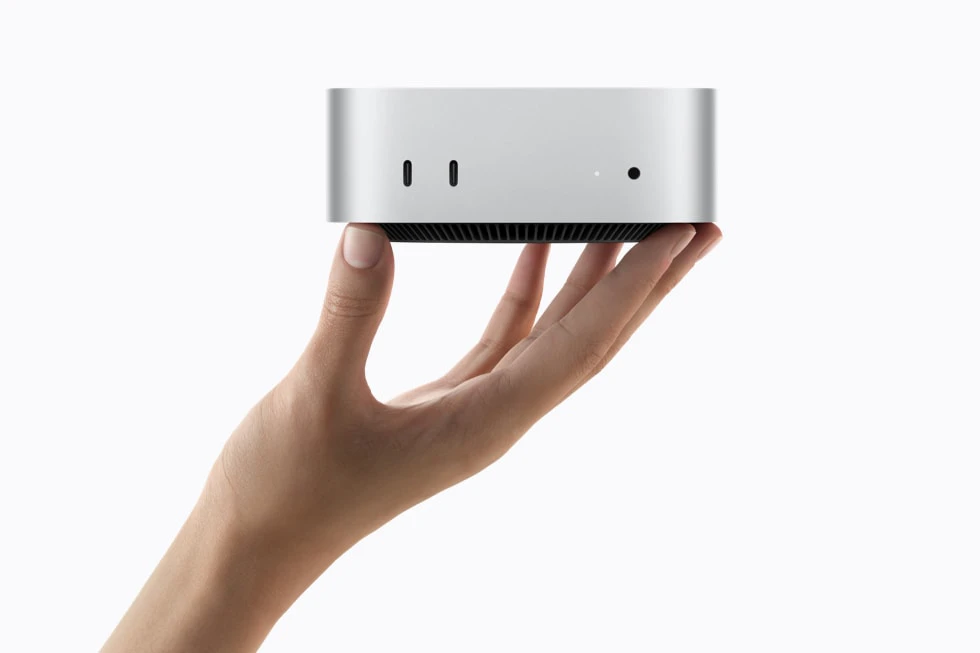
Apple’s new Mac mini has moved to M6, and the Canadian starting price is now $1,249.
The August 25 refresh is more than a routine processor swap. M6 is Apple’s first 2-nanometre Mac chip, the base Mac mini gets a larger CPU and GPU, Apple has doubled down on local AI performance, and the machine finally adds Wi-Fi 7, Bluetooth 6 and faster standard Ethernet.
For Canadians deciding whether to upgrade, though, the useful question is simpler: does the new hardware justify paying four figures for the smallest desktop in Apple’s lineup?
The Canadian lineup starts at $1,249
Apple says the M6 Mac mini starts at $1,249 CAD, or $1,109 with eligible education pricing. The higher-end Mac mini with M5 Pro starts at $2,399 CAD, with education pricing from $2,259.
Pre-orders opened August 25 and deliveries begin September 22.
The base M6 model ships with 16GB of unified memory and can be configured up to 32GB. The M5 Pro version supports up to 64GB. That distinction matters more than the marketing language about AI because memory remains the practical ceiling for many local-model, development and creative workloads.
M6 is Apple’s first 2 nm Mac chip
Apple says M6 uses a 2-nanometre manufacturing process and includes a 12-core CPU, a 12-core GPU with Neural Accelerators and a dual 16-core Neural Engine. Memory bandwidth reaches 170GB/s.
Compared with the previous M4 Mac mini, Apple claims up to 40 percent faster CPU performance, twice the graphics performance and as much as four times the AI performance in selected workloads.
Those are Apple’s own benchmark claims, so they should not be confused with independent testing. The numbers do show where Apple has spent its transistor budget: CPU gains are meaningful, but the company is putting much more emphasis on GPU-based machine-learning acceleration and local model execution.
For someone browsing the web, writing documents and streaming video, that AI headroom is unlikely to transform the experience. For developers running local LLMs, photo tools, coding models or automation workloads, it is much easier to justify.
The networking upgrade may matter longer than the AI slogans
Both new Mac mini models now support Wi-Fi 7 and Bluetooth 6. Apple also moves the standard wired connection to 2.5Gb Ethernet, with 10Gb Ethernet available as an option.
That is a welcome change for a desktop that often ends up serving as a small server, media machine or always-on development box. Gigabit Ethernet is still fast enough for normal internet use, but 2.5Gb networking is increasingly useful for local NAS storage, large file transfers and faster home networks.
The M6 version keeps three Thunderbolt 4 ports on the rear. The M5 Pro model gets Thunderbolt 5, which offers more bandwidth for demanding storage, displays and expansion hardware.
Apple is openly pitching Mac mini as an AI box
Apple’s language around this generation is unusually direct. It calls Mac mini suitable for “always-on agentic computing” and highlights running large language models locally rather than sending every task to a cloud service.
That is not just trend-chasing. A small, quiet desktop with unified memory has become an attractive way to run local inference because the CPU and GPU can access the same memory pool without copying data between separate system and graphics memory.
There is still a catch: the base M6 model tops out at 32GB. That is plenty for ordinary use and some compact local models, but anyone buying specifically for larger AI workloads should think about memory before processor tier. You cannot upgrade unified memory later.
The M5 Pro model’s 64GB ceiling gives it considerably more room, although at $2,399 before upgrades it enters a different budget category.
Gaming gets a real bump, but this is still a Mac
Apple says Cyberpunk 2077 with ray tracing can run up to twice as fast on M6 compared with M4 in its test configuration. The GPU also adds Neural Accelerators and updated ray-tracing hardware.
That is good news for the growing number of native Mac games, but hardware is only half the equation. Windows still has the deeper game library and broader anti-cheat support. Nobody should buy a Mac mini primarily for gaming because an Apple benchmark says one title doubled in performance.
What the stronger GPU does change is the margin. A Mac mini purchased for work can now be a considerably more credible casual gaming machine on the side.
Should an M4 Mac mini owner upgrade?
For most people, no.
M4 remains a recent and capable processor. The M6 generation is faster, but normal productivity work is unlikely to expose enough difference to justify replacing a functioning M4 machine after such a short interval.
The stronger case exists if you specifically need one of the new capabilities: faster local AI, Wi-Fi 7, 2.5Gb Ethernet, a heavier GPU workload or a larger performance envelope for software development.
Owners of older Intel Mac minis or early Apple-silicon models have a much clearer upgrade case. Apple’s own comparisons show very large gains against M1-era hardware, and the new networking and port standards make the machine more future-proof.
The real buying decision is M6 versus M5 Pro
The base M6 Mac mini is the obvious value option for general users. At $1,249 CAD it provides the newest architecture, 16GB of memory, stronger graphics and modern networking without pushing into workstation pricing.
The M5 Pro version makes sense when the workload can actually use additional CPU/GPU cores, Thunderbolt 5 or more than 32GB of unified memory. Buying it “just in case” is an expensive form of insurance.
That is also why the new Mac Studio exists. Apple’s August 25 desktop refresh stretches all the way to M5 Ultra and 512GB of unified memory for professionals running workloads that would simply overwhelm a Mac mini.
M6 makes the Mac mini more capable, not automatically better value
The new Mac mini is technically impressive. A 2 nm processor, faster local AI, Wi-Fi 7 and 2.5Gb Ethernet in a machine this small would have sounded absurd a few years ago.
But the price still matters. At $1,249 CAD before a monitor, keyboard, mouse or storage upgrades, “mini” no longer means inexpensive.
For Canadians, the best version of this purchase is therefore the boring one: buy the base M6 model if it already meets your memory and storage needs, and move up only when a real workload can explain where the extra money goes.