Meta’s One-GPU AI Could Matter More Than Benchmarks
Matthew Leo · Published August 11, 2026 · AI
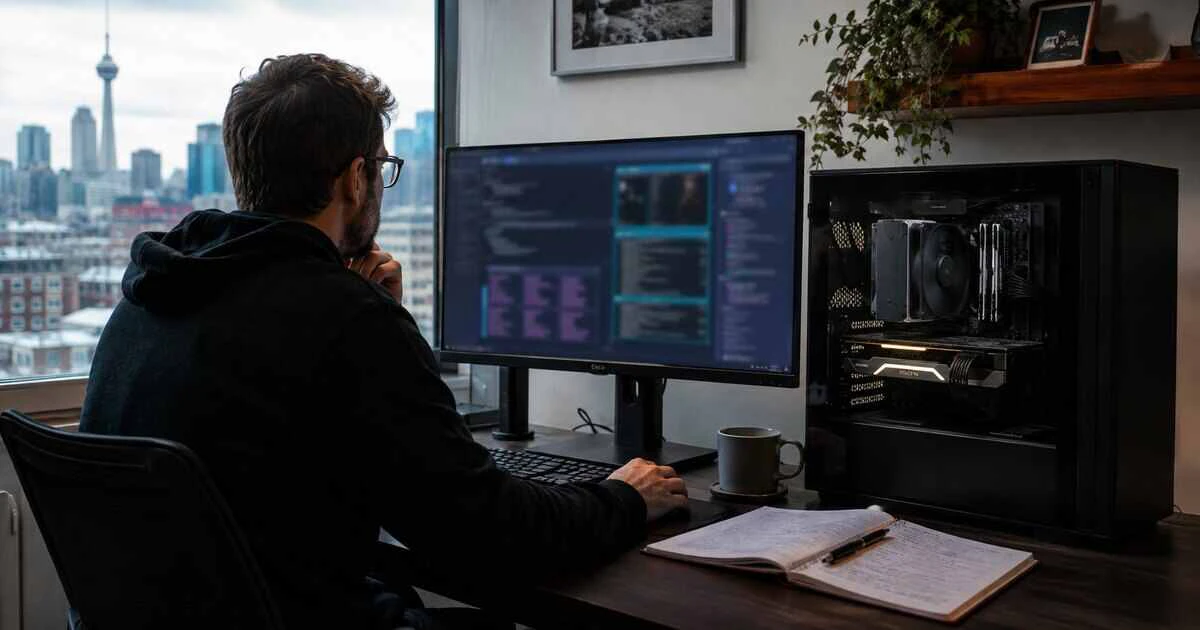
Meta’s most important AI release this week may not be its most powerful model. It may be the one that can leave the data centre.
Muse Glimmer is a 30-billion-parameter, open-weight model designed for local agents. Meta says a compressed version can operate on a Mac or PC with one capable consumer graphics processor, letting developers run tasks without continuously sending prompts and files to a cloud service.
For Canadian businesses, universities and public institutions, that could be more consequential than another narrow benchmark victory. Local inference can reduce external data transfers, continue working during an outage and give an organization more control over the complete system. It also moves costs and security responsibilities onto the machine sitting under the desk.
What Meta released
Meta introduced Muse Glimmer on August 10 under the Apache 2.0 licence. It is trained for agentic work, including tool use, coding, multi-step reasoning, image understanding and recovery after a failed tool call.
“Open-weight” means the trained parameters can be downloaded and used outside Meta’s hosted service. It does not necessarily disclose every dataset, training decision or internal development process, so the term should not be treated as identical to completely open-source software.
The model’s ordinary full-precision form would require more than 55 GB of memory. Meta says its roughly four-bit compressed version reduces the language-model component to under 20 GB, leaving room for working memory and related components inside a 24 GB or 32 GB hardware envelope.
That is technically one graphics processor. It is not the graphics processor found in an inexpensive family laptop.
Local AI changes where the data travels
A cloud assistant normally receives a prompt, processes it on the provider’s infrastructure and returns an answer. A genuinely local model can perform that work on equipment controlled by the user or organization.
That distinction can matter when an agent must inspect:
- Internal documents and unpublished research
- Source code and security reports
- Customer or employee information
- Files stored in a regulated environment
- Material that cannot tolerate an Internet outage
Canada’s Cyber Centre has noted that local storage can reduce exposure to cloud-related vulnerabilities. That is a useful benefit, but “local” must describe the complete workflow rather than only the model file.
An application can run the model locally while transmitting usage analytics, downloading external content or sending tool results to another service. Organizations should test network behaviour and read the surrounding software’s terms instead of inferring privacy from a model label.
The computer becomes part of the AI budget
Cloud AI turns much of the cost into a recurring service bill. Local AI moves more of it into hardware, electricity, maintenance and staff time.
| Question | Cloud model | Local model |
|---|---|---|
| Initial hardware | Usually modest | Potentially substantial |
| Usage cost | Often charged by subscription or tokens | Electricity and equipment depreciation |
| Internet requirement | Normally required | Can operate offline |
| Data location | Depends on the provider | Can remain on controlled equipment |
| Maintenance | Mostly handled by the provider | Handled by the operator |
| Model changes | Can occur without local control | Version can be preserved |
A local deployment can become economical when the hardware is already available and the workload is steady. It can be wasteful when an organization purchases an expensive workstation for occasional questions that a smaller hosted account would handle more cheaply.
The calculation should include expected prompts, electricity, useful hardware life, staff support and the cost of downtime. “No token bill” is not the same as free.
An agent with local access can still cause local damage
Muse Glimmer is designed for agents that call tools, organize files and complete extended tasks. Those abilities make it useful, but they also widen the consequences of a bad instruction or compromised document.
A locally operated agent may be able to delete files, execute commands, expose credentials or alter a project without involving Meta’s infrastructure. Keeping data off the cloud does not protect it from software already authorized to reach it.
Start with a restricted environment:
- Give the agent access only to a copied test directory.
- Remove production credentials and customer data.
- Disable unnecessary network and command-execution tools.
- Require approval before deletion, payment, publishing or deployment.
- Record the exact model and software versions used.
- Preserve logs showing each tool call and resulting change.
Meta says Glimmer was evaluated under its Advanced AI Scaling Framework. Independent testing will still be necessary, particularly because an open-weight release can be modified, combined with different scaffolding and granted access Meta did not evaluate.
Local models fit Canada’s sovereignty debate
Ottawa is investing in domestic computing capacity through the Canadian Sovereign AI Compute Strategy. Large national systems matter for training and research, but sovereignty is not limited to owning enormous data centres.
A Canadian organization that can run a useful model on its own equipment gains another form of independence. It can preserve a working version, choose when to update and avoid making every task dependent on a foreign provider’s availability or product decisions.
That independence is not automatic compliance. The organization remains responsible for the information it uses, the software it installs and the actions its agent takes. Open weights transfer control; they also transfer work.
Wait for evidence from ordinary hardware
Meta’s published results compare Muse Glimmer with similarly sized models, but vendor benchmarks do not reveal how the model performs inside a real Canadian workplace.
The useful tests will measure complete tasks on hardware people can actually buy: setup time, memory use, response speed, French and English performance, tool-call accuracy, failure recovery and the damage caused when an agent follows a malicious instruction embedded in a document.
Muse Glimmer makes a credible case that capable agents do not always require a warehouse of servers. Whether that becomes useful independence or an expensive new security problem depends less on the benchmark table than on what the local computer is allowed to do.
Tags: Meta, Muse Glimmer, local AI, open-weight models, Canadian technology