Micron’s $10B Lab Exposes Canada’s Memory Gap
Matthew Leo · Published August 21, 2026 · Business & Policy
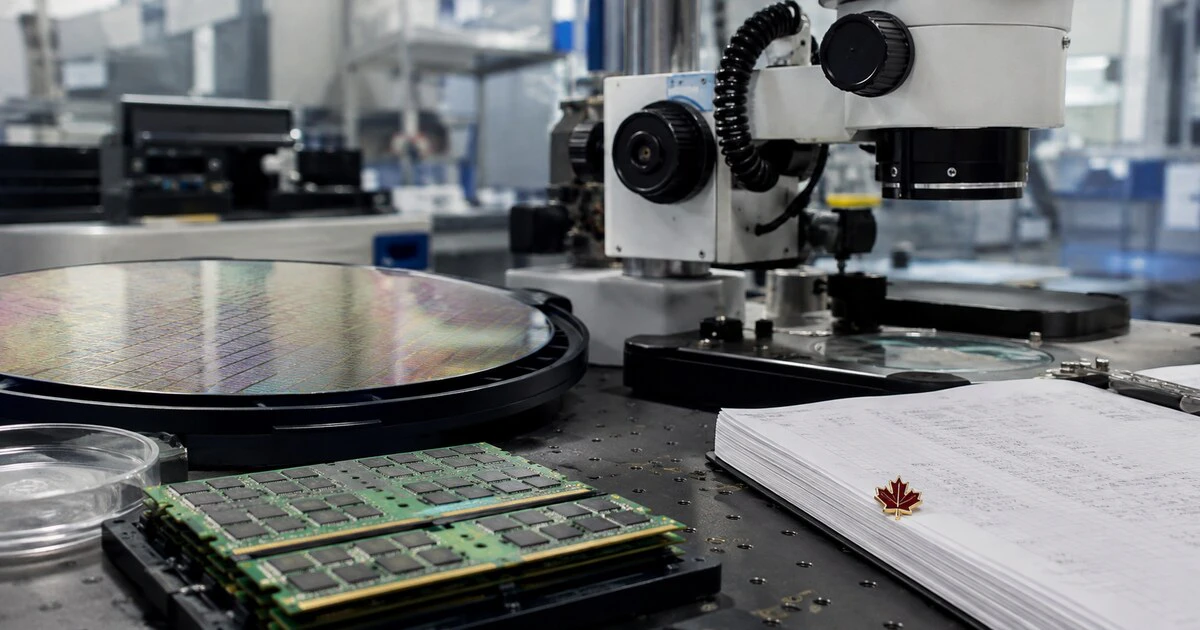
Micron’s new US$10-billion memory research commitment makes Canada’s semiconductor ambition look less like a strategy and more like a collection of promising parts.
The comparison is not entirely fair: Micron is a global manufacturer investing over a decade in its home city of Boise, Idaho. It is still useful. AI infrastructure depends on memory as well as processors, and countries that capture only data-centre construction risk renting the most valuable technology from abroad.
Micron is investing in the layer beside the AI chip
Micron said on August 20 that it plans to spend US$10 billion over ten years on a new Boise research lab. The company says the work will cover memory technologies, computing systems and future semiconductor manufacturing.
Memory is not storage in the everyday hard-drive sense. In an AI server, specialized high-bandwidth memory has to move enormous amounts of data to and from accelerators quickly enough to keep expensive processors working. A shortage or performance bottleneck in that layer can limit the whole system.
Micron’s announcement comes as memory manufacturers benefit from AI infrastructure demand. The company’s own release describes the lab as long-horizon research. That matters because the investment is designed to shape future products, manufacturing techniques and engineering talent, not simply add another building to an existing production line.
Canada has capability, but its spending is fragmented
Invest in Canada says the country has more than 500 semiconductor companies across research, design and manufacturing, with particular strength in specialized technologies. Canada is not starting from zero.
The FABrIC program, led by CMC Microsystems, is supported by a $120-million federal investment over five years. Its goal is to help researchers and companies design, prototype, manufacture and commercialize semiconductor products.
That is useful infrastructure. It is also about one-eightieth of Micron’s announced lab commitment before currency conversion, and it serves a broad national ecosystem rather than one tightly integrated commercial research centre. The scale difference should discourage loose claims that Canada is about to become a semiconductor superpower.
| Canada’s position | Practical implication |
|---|---|
| Strong research and design talent | Focus support where Canadian teams already have defensible expertise |
| Limited leading-edge mass manufacturing | Avoid promising a full domestic supply chain that funding cannot sustain |
| Growing AI data-centre demand | Use procurement to create customers for Canadian components and services |
| Public prototyping infrastructure | Measure whether prototypes reach production and recurring revenue |
Trying to copy Boise would be the wrong response
Canada does not need to match Micron dollar for dollar or build every type of chip. A credible strategy would choose areas where Canadian research, customers and manufacturing partners overlap.
Photonics is one candidate because optical links are increasingly important inside and between data centres. Power management, advanced packaging, sensors, testing and chip-design tools are others. The point is not to declare a winner from Ottawa. It is to require programs to show how a technical advantage becomes repeatable production.
Public support should follow milestones: a working prototype, an independent customer, qualified manufacturing capacity and a path to scale. Counting patents and announcements without tracking production creates a research program, not an industrial strategy.
Data-centre deals should carry semiconductor conditions
Canada is already using public policy to attract AI computing infrastructure. Those projects can help the semiconductor sector if procurement rules are designed carefully.
A supported data centre could be required to publish how much it buys from Canadian suppliers, which components were evaluated, and why a domestic option was rejected. That does not mean forcing operators to buy unsuitable equipment. It means turning large public-supported projects into transparent reference customers instead of isolated power consumers.
Universities also need access to the real operating problems inside modern clusters. Cooling, networking, memory management, reliability and energy efficiency all create research opportunities. Agreements should protect security and commercial secrets while still producing publishable knowledge and Canadian intellectual property.
Consumers will feel the memory market before policy catches up
Memory demand does not stay inside data centres. When high-margin AI products absorb manufacturing capacity and investment, prices and availability can shift across servers, laptops and other electronics. That does not guarantee every device will become more expensive, but it makes memory configuration a more important buying decision.
For Canadian shoppers, paying for enough RAM at purchase can be safer than assuming an upgrade will remain cheap or even possible. Many thin laptops solder memory to the main board. A slightly cheaper configuration can become the expensive one if it has to be replaced early.
Micron’s lab is a reminder that the valuable layers of AI infrastructure extend well beyond the headline accelerator. Canada’s opportunity is not to own all of them. It is to identify a few it can build, manufacture and sell at a scale that survives the next funding announcement.
Source note: Investment figures and program descriptions were last checked August 21, 2026. Dollar comparisons do not adjust for exchange rates or different program scopes.
Tags: semiconductors, memory, Canada, AI infrastructure, industrial policy