NASA’s US$10B Moon Contract Is a Ceiling, Not a Payout
Mapletechie Editorial · Published November 8, 2026 · Business & Policy
Business analysis
NASA selected eight companies on November 7 for the next phase of its commercial Moon-delivery programme. The largest number in the announcement needs a careful reading: US$10 billion is the combined contract ceiling, not a payout to each company.
NASA’s announcement names Blue Origin, Firefly Aerospace, Intuitive Machines, ispace US, Lockheed Martin, Northrop Grumman, SpaceX and Voyager Technologies. They are eligible to compete for future lunar surface delivery missions under Commercial Lunar Payload Services 2, or CLPS 2.
Eligibility, orders and revenue are different
The ten-year framework is a multiple-award, indefinite-delivery/indefinite-quantity contract. In plain language, NASA has established a group of providers from which it can order services as mission needs develop.
Three distinctions help make sense of subsequent announcements:
- Vendor selection: A company joins the pool and can compete for work.
- Task order: NASA selects a provider for a specific delivery or service, with its own terms.
- Contract ceiling: The maximum potential value of the overall vehicle, not a guarantee that NASA will spend that amount.
Firefly’s release describes its selection as positioning it to compete for task orders. Voyager likewise describes eligibility, including for a wider range of lunar missions. Neither statement turns the shared ceiling into guaranteed company revenue.
The older delivery programme continues
NASA also increased the ceiling of the existing CLPS contract from US$2.6 billion to US$4.2 billion. That is a US$1.6-billion increase, about 61.5%, in authorized ceiling capacity. It is not evidence that spending immediately rose by the same amount.
The overlap matters: CLPS 2 does not make previously awarded missions disappear. Readers should check which contracting vehicle and task order a company is discussing before adding figures together.
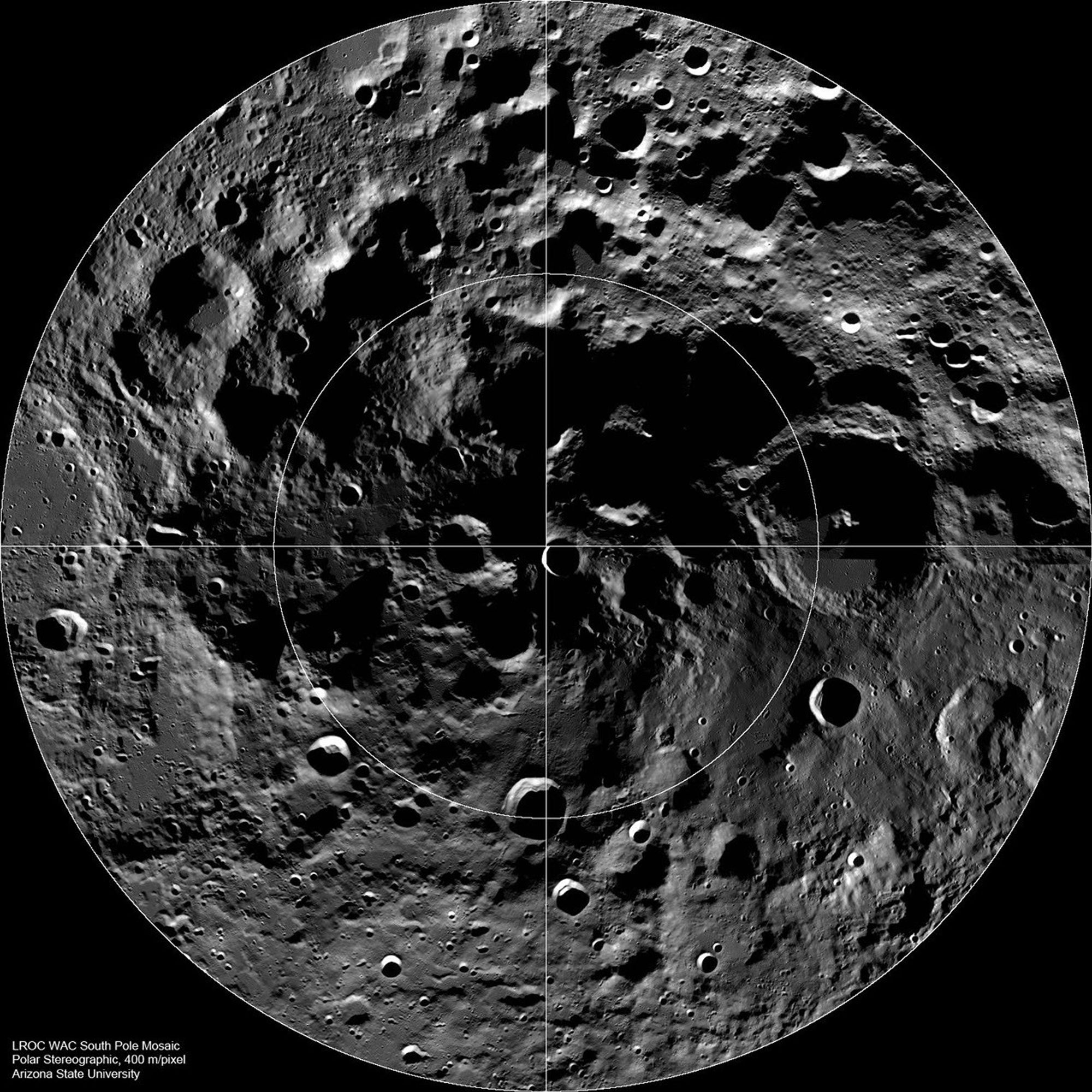
Lunar south-pole mosaic from NASA’s Lunar Reconnaissance Orbiter. Bright rims and deep shadows help explain the region’s infrastructure challenges. Credit: NASA/GSFC/Arizona State University. Image source.
Cargo delivery is not the crewed landing
These services transport science, technology and infrastructure payloads. They should not be confused with the crewed Artemis landing missions, whose architecture and readiness requirements are separate. Mapletechie’s Artemis III explainer covers that distinction.
For suppliers and investors, the next meaningful milestones are actual orders, delivery requirements and mission performance. Joining the pool creates an opportunity; winning and executing the work determines what it is worth.
Tags: NASA, Artemis, Moon, Space Exploration