OpenAI Says GPT-6 Cyber Validated 948 Linux Kernel Flaws
Matthew Leo · Published November 7, 2026 · AI
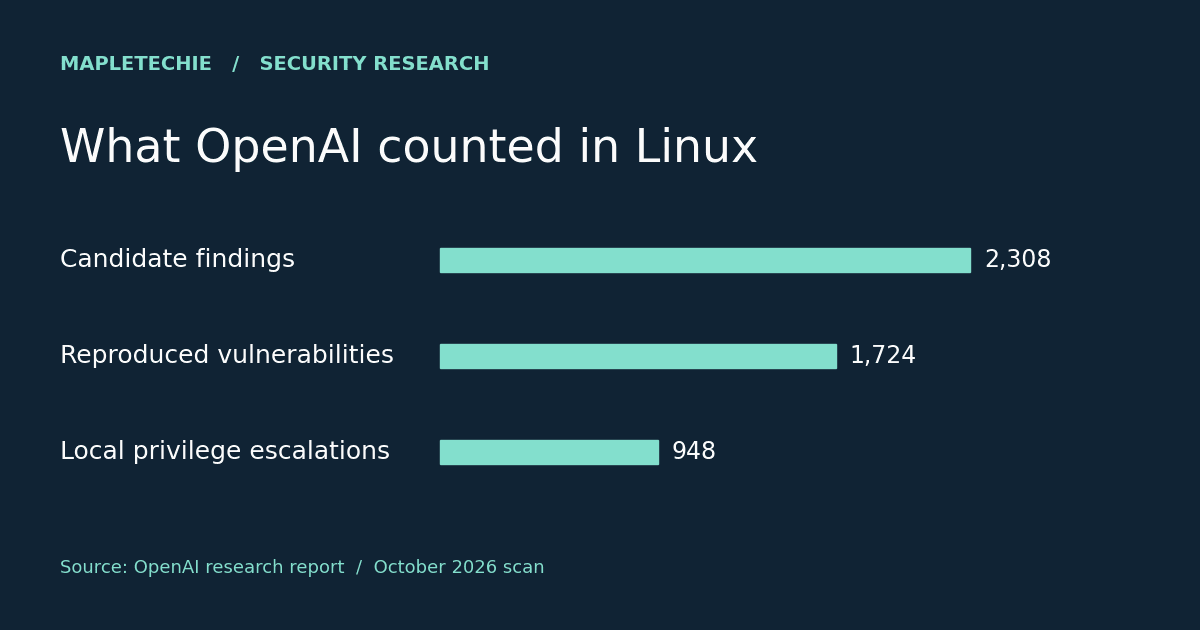
OpenAI says its GPT-6 Cyber research system verified 948 distinct Linux kernel flaws that could let a user with limited access gain control of a test machine. The company also generated a proposed fix for each one. By the time researchers finished checking the results, Linux developers had already fixed dozens of the problems.
That overlap matters. The 948 figure describes what OpenAI could demonstrate in its lab. It does not mean the team was first to discover every flaw, that 948 fixes have shipped, or that attackers have used them on real machines.
What the researchers counted
The kernel is the part of Linux that decides, among other things, which programs can access memory, devices and files. An ordinary account should not be able to overrule those decisions. The flaws in this count allowed a local user to gain “root,” the highest level of access. Someone would already need a foothold on the machine; the experiment did not demonstrate 948 ways to break in from the internet.
The numbers in OpenAI’s November 4 research report describe different stages of the same test. The team started with 2,308 candidate findings and reproduced 1,724 vulnerabilities. The 948 is the narrower group for which the researchers demonstrated elevated access and identified distinct fixes. Adding the three figures together would count some of the same work more than once.
Ten days changed the patch list
The researchers worked from a mid-October version of the kernel. Ten days later, they found that 61 of the issues already had fixes in the main Linux development tree. Another 43 had patches in staging, and 299 were already being reported and discussed in public. Those figures describe the state of the work when the team checked, not a list of bugs that remain open today.
OpenAI put the run at about US$1.2 million in API credits. That buys a useful measure of computing cost, but it leaves out a major part of the job: people still have to review a proposed fix, decide whether it belongs in the kernel and get it to users. A fix accepted by Linux developers and an update installed on a company’s servers are two different milestones.
For anyone responsible for a Linux fleet, the practical question is which fixes their distribution has shipped for the kernel they actually run. The company’s GPT-6 Cyber announcement identifies the model behind the research. It is the distribution’s security advisories and installed updates that tell an administrator what has changed on a particular machine.