Can You Bring a Power Bank on a Canadian Flight?
Matthew Leo · Published August 6, 2026 · Guides
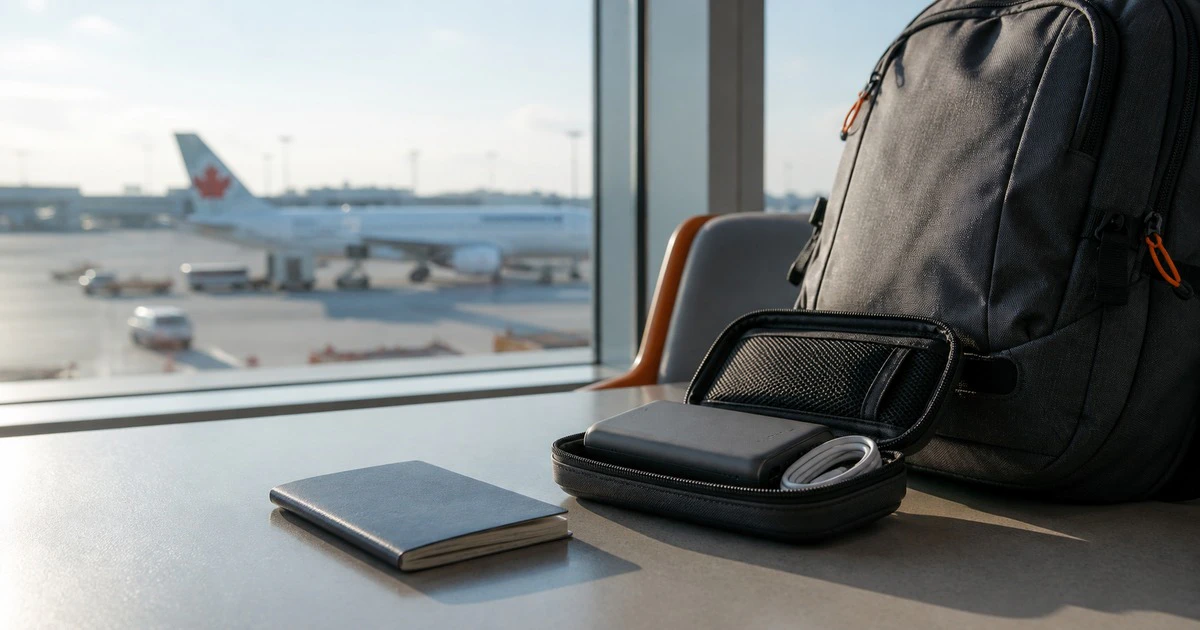
A power bank can travel with you on a Canadian flight, but putting it in the wrong bag can stop the trip before it starts.
The simple rule is to keep a normal phone power bank in your carry-on, protect it from damage and check the airline's limit before leaving home. Do not place it in checked baggage. If a carry-on bag is taken at the gate, remove the power bank before the bag goes into the hold.
Rules have tightened in 2026, and some airline pages are stricter than older travel advice. Here is the safe way to pack.
Keep power banks in the cabin
Transport Canada says power banks and spare lithium batteries belong in carry-on baggage. The reason is not convenience. If a lithium battery overheats, cabin crew can see and respond to the problem. A fire in the cargo hold is harder to reach.
CATSA also tells travellers to carry power banks in the cabin. Its battery guide warns against damaged, swollen or recalled batteries and tells passengers to review the airline's policy.
This applies even when the power bank is built into smart luggage. If the bag is checked, the removable battery must come out and stay with the passenger. A bag with a large non-removable battery may not be accepted.
The number on the label matters
Look for a watt-hour rating written as "Wh" on the power bank. Current 2026 guidance from the International Air Transport Association allows up to two lithium-ion power banks of no more than 100 Wh each in carry-on baggage. It lists power banks above 100 Wh as forbidden for passengers, even though some broader battery rules allow certain non-power-bank batteries up to 160 Wh with airline approval.
Airlines can be stricter. WestJet's current baggage policy allows one power bank, requires it to stay on the passenger or in the seat pocket, and says it cannot be stored in the overhead bin. It also bans charging the power bank during the flight and restricts using it to charge another device.
That difference is why "the internet says two" is not enough. Check the operating airline for every part of the trip, including a partner airline on a connecting flight.
How to understand mAh and Wh
Many power banks advertise capacity in milliamp-hours, or mAh, while aviation rules use Wh. The label should show both. If it does not, the manufacturer may list the watt-hour rating in the manual or product page.
The calculation is:
Wh = mAh x nominal voltage / 1,000
A 20,000 mAh bank rated at 3.7 volts is about 74 Wh. A 27,000 mAh bank at 3.7 volts is about 99.9 Wh. The advertised USB output voltage is not necessarily the battery's nominal cell voltage, so use the manufacturer's rating instead of guessing.
A missing or unreadable label can cause trouble at check-in or security. For travel, choose a reputable product with its capacity and certification marks printed clearly on the case.
Pack it so nothing can short the terminals
Keep the power bank in its original package, a protective pouch or a separate plastic bag. Do not let loose coins, keys or metal tools touch exposed contacts. If the design has open terminals, cover them with non-conductive tape.
Do not pack the bank where a seat mechanism can crush it. IATA guidance says it should not be kept in an overhead locker. A seat pocket or small bag under the seat keeps it visible and reachable, subject to the airline's instructions.
If the case is swollen, cracked, unusually hot, leaking or recalled, leave it at home and follow local disposal instructions. Transport Canada specifically warns that recalled power banks present an aviation risk.
Do not charge it in the air
Current IATA guidance says power banks must not be recharged from the aircraft's power supply. It also says they should not be used to charge another device during taxi, takeoff or landing. Some airlines extend that restriction to the full flight.
Charge the phone and power bank before reaching the airport. Put the phone in low-power mode, download boarding passes and maps, and use the seat's built-in power only if the airline permits it. Follow cabin-crew instructions even when they are stricter than the general rule.
A five-minute check before leaving
- Read the Wh rating and confirm it is 100 Wh or less.
- Check the operating airline's current power-bank page.
- Confirm the unit is not damaged or recalled.
- Pack it in a pouch in carry-on baggage, away from metal objects.
- Remove it if the carry-on is gate-checked.
For more practical travel and device help, see Mapletechie's Guides section.
The safest answer
For most Canadian travellers, a clearly labelled power bank under 100 Wh is the easy choice. Carry only the number the airline allows, keep it close and do not charge it in flight unless the crew and policy clearly permit use.
A battery is useful when a delayed flight leaves the phone at 10 percent. It is much less useful when it is buried in a checked suitcase or rejected because nobody can read its rating.