Satellite Phone Features in Canada: What Actually Works
Matthew Leo · Published July 31, 2026 · Canada Tech
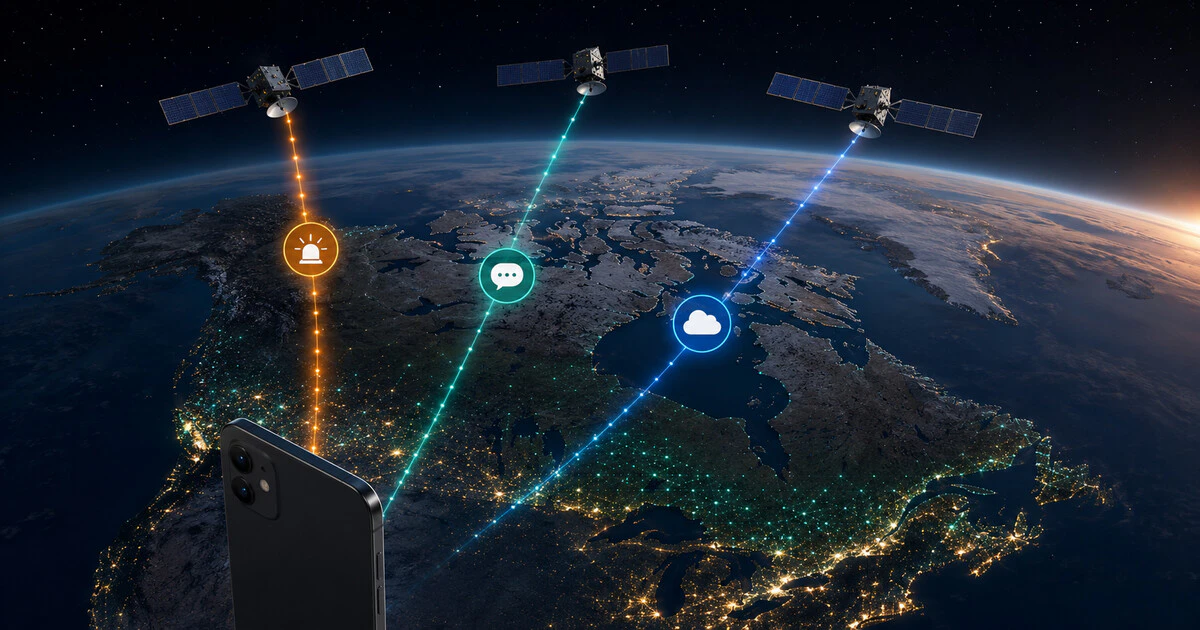
“Satellite support” can mean anything from one emergency message to ordinary texting and selected applications—and those are not remotely the same service.
Canadians can now access satellite features through supported iPhones, newer Pixel phones and Rogers’ satellite-to-mobile network. The services differ in devices, coverage, price and what users can actually do.
The short Canadian comparison
| Service | Main purpose | Supported devices | Canadian availability |
|---|---|---|---|
| Apple Emergency SOS | Contact emergency services | iPhone 14 and newer | Available in Canada |
| Apple Messages via satellite | Send iMessage or SMS when off-grid | iPhone 14 and newer | Available in Canada |
| Google Satellite SOS | Contact emergency services | Pixel 9 generation and newer, excluding Pixel 9a | Available in Canada |
| Rogers Satellite | Texting and selected applications | Compatible unlocked phones | Generally south of 58° north, with exclusions |
Compatibility, pricing and software requirements can change. Confirm the exact model and plan before depending on any feature.
Apple Emergency SOS is for emergencies
Apple’s Emergency SOS via satellite works in Canada on iPhone 14 and newer models running supported software.
When cellular and Wi-Fi networks are unavailable, the phone can guide the user toward a satellite and send a structured emergency message. Location and Medical ID information can also be shared when configured.
The connection requires a relatively clear view of the sky. Trees, terrain, buildings and other obstructions can slow or prevent delivery.
Apple includes the feature without an additional charge for two years after activation of an eligible iPhone. That policy could change, so it should not be treated as a lifetime guarantee.
Apple Messages adds ordinary off-grid communication
Messages via satellite allows supported iPhones to send iMessage and SMS when neither cellular nor Wi-Fi service is available.
It is separate from Emergency SOS. An emergency should still be sent through the emergency workflow.
Satellite messaging has important limitations:
- Photos, videos and audio messages are not supported.
- Group messages are not supported.
- Connections may take approximately 30 seconds in ideal conditions.
- Light or medium foliage can push delivery beyond one minute.
- Heavy foliage or obstruction can prevent a connection.
iMessage must be configured before going off-grid. Someone planning a remote trip should use Apple’s demonstration mode beforehand instead of discovering the interface during an emergency.
Google Satellite SOS is emergency-focused
Google Satellite SOS is available in Canada on supported Pixel phones.
Google currently lists Pixel 9-generation devices and newer, excluding the Pixel 9a. The device must have current software and complete the required registration.
Like Apple’s emergency service, Satellite SOS requires a clear view of the sky and is intended for situations where ordinary cellular or Wi-Fi connections are unavailable.
It does not provide general satellite texting across every conversation or application.
Open Settings and search for Satellite SOS before travelling. If the option is absent, do not assume it will mysteriously appear after reaching a forest.
Rogers offers the broadest everyday feature set
Rogers Satellite allows compatible phones to connect directly to satellites when terrestrial cellular coverage is unavailable.
The current service supports:
- Text messaging
- Text-to-911
- WhatsApp voice and video calls
- Facebook Messenger
- Google Maps
- Selected weather, navigation and outdoor applications
Application support is selective. The service does not transform every application or high-bandwidth activity into a normal satellite connection.
Delivery can be delayed, limited or unavailable depending on location, sky visibility, device and satellite position.
Rogers is not limited to Rogers mobile customers
Rogers says its satellite service is available to Canadians using other mobile providers through a compatible unlocked phone and a Rogers satellite eSIM.
Its current consumer page lists the service as included with newly activated Rogers 5G+ plans. Other Rogers customers can add it for a promotional C$10 per month for the first 12 months, currently rising to C$15 afterward. New non-Rogers customers are shown a C$15 monthly price.
Those are advertised prices before applicable taxes and future changes.
Rogers’ setup documentation explains that customers using another carrier may need to make the Rogers satellite eSIM primary for messaging and data while connected.
Anyone considering the service should confirm how that affects ordinary calling, messaging and account configuration before a trip.
Northern coverage is the largest limitation
Rogers describes the current service as generally available south of the 58th parallel, excluding several specified regions.
That boundary leaves substantial parts of Yukon, the Northwest Territories and Nunavut outside the advertised service area.
This matters because satellite marketing often uses “Canada-wide” language loosely. A feature can be available to Canadians without physically covering all of Canada.
Apple and Google describe broader emergency availability by supported country, but real-world connections still depend on terrain, sky visibility and satellite access.
None of these connections is guaranteed rescue
Consumer satellite features can materially improve safety. They remain dependent on hardware, software, battery power, weather, obstruction and service availability.
Before remote travel:
- Confirm the exact phone and software are supported.
- Install updates before leaving terrestrial coverage.
- Complete registration and demonstration modes.
- Charge the phone and carry backup power.
- Download offline maps.
- Tell a trusted person the planned route and return time.
- Do not promise that a satellite message will always arrive immediately.
A satellite icon is an extra layer of communication, not permission to ignore ordinary trip planning.
Which option fits which user?
Choose Apple Emergency SOS when:
You already own a supported iPhone and primarily need an emergency fallback without adding a separate monthly service.
Use Apple Messages via satellite when:
You want basic off-grid communication with existing contacts and can accept slow, text-only conversations.
Use Pixel Satellite SOS when:
You own a supported Pixel and need emergency communication rather than ordinary satellite messaging.
Consider Rogers Satellite when:
You need texting or selected applications away from terrestrial coverage, will be travelling inside its supported area and have confirmed device compatibility.
Read the verbs, not the satellite logo
One service can contact emergency responders. Another can send ordinary text. Another supports a small group of applications.
All may be advertised with the same satellite imagery.
Before relying on one, ask exactly what it can send, where it works, what it costs and what happens when the sky is not clear.
That answer matters considerably more than the icon beside the signal bars.
Tags: satellite service, iPhone, Pixel, Rogers, Canadian telecom