A Tesla FSD Crash Exposes the Supervision Problem
Matthew Leo · Published August 3, 2026 · News
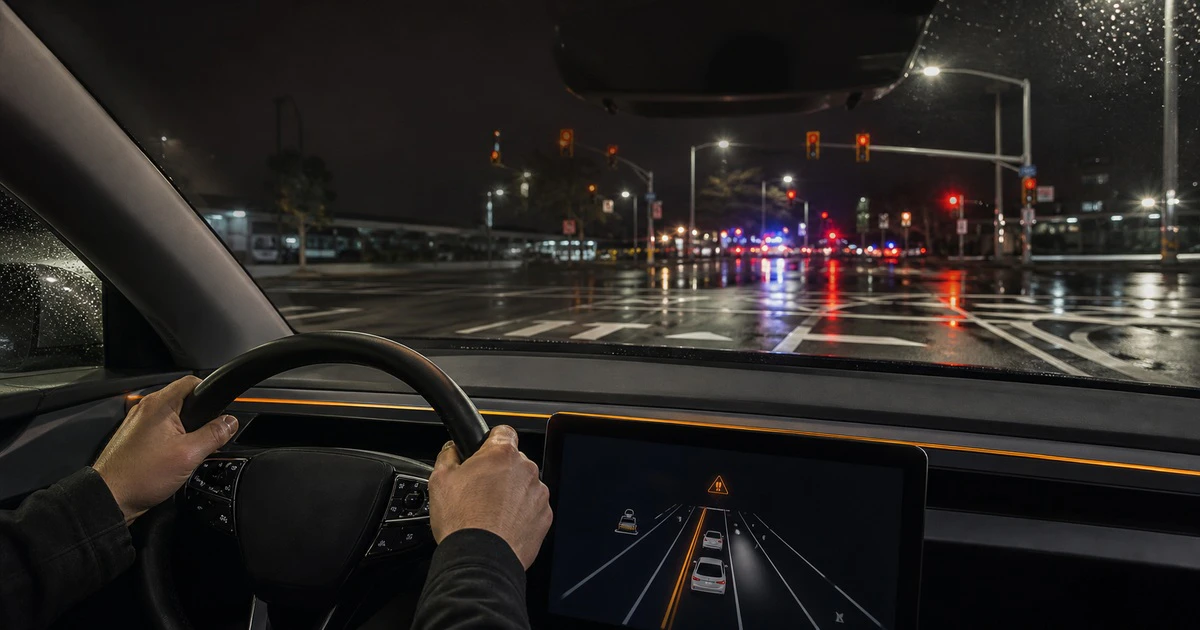
A car can be good at driving and still be dangerous to trust at the wrong moment.
That is the hard question raised by a viral post from William Chen, who uses @solidwillity on X. On August 2, Chen said he was a passenger in a Tesla that crashed while Full Self-Driving (Supervised) was engaged. His post included photos and short videos from the scene and hospital.
Chen did not use the crash to attack Elon Musk or Tesla. He said he still supports the people building the technology. Instead, he asked how the car saw the scene, how it classified objects and what decisions it made before the impact.
That measured response is what makes the story more important. The future of automated driving will not be decided only by supporters and critics shouting at each other. It will be decided by whether people can understand what the system did when something went wrong.
Content note: Chen’s embedded post contains crash and hospital images.
https://x.com/solidwillity/status/2083995791342145651
What we know—and what we do not
Chen’s public account says he was the passenger and FSD was on. He described serious injuries, repeated hospital visits and concern about his eyesight. By early August 3, the post had been viewed more than 700,000 times.
The public post does not establish what caused the crash. It does not provide the vehicle’s event data, the exact FSD version, a police report or a complete view of what the driver and system did in the seconds before impact. Mapletechie could verify Chen’s post and the attached media, but not the cause of the collision.
That distinction matters. Saying FSD was engaged is not the same as proving FSD caused the crash. Any honest analysis has to leave room for driver action, another road user, road design, weather, visibility, a software mistake or several factors at once.
It is also why Tesla should make clear post-crash records available to investigators and affected occupants. Without that evidence, the public is left to argue from photos, loyalty and suspicion.
How FSD sees and decides
Tesla’s Model 3 owner’s manual gives a simple outline. Cameras at the front, rear and sides send visual information to the car’s AI computer. The computer processes neural networks, builds a model of the area and makes driving decisions.
The display may show lanes, vehicles, pedestrians, bicycles and other objects. Tesla also warns that the screen is not a complete picture of everything the system considers. A driver can look at the display and still not know exactly why the car chose a speed, path or turn.
Rain, faded lane markings, blocked cameras and complex intersections can affect performance. Tesla says the driver must stay attentive and be ready to take immediate action.
That is the official answer to Chen’s technical questions: perception starts with cameras, and the main inference happens on the vehicle. The harder answer is that people outside Tesla cannot reconstruct a specific decision without detailed logs.
The supervision paradox
Tesla calls the product Full Self-Driving, but the important word is “Supervised.” It remains a Level 2 driver-assistance system. It can steer, accelerate, brake, change lanes and handle intersections, but the human driver remains responsible.
This creates a strange job. The system does enough driving to encourage trust, while the human must watch closely for the rare moment when that trust becomes unsafe.
A driver is not simply waiting to touch the wheel. They must notice that the system is wrong, understand the danger, choose the right response and act before the situation becomes impossible to save. If the warning comes too late, the legal instruction to remain alert may not solve the design problem.
Researchers at the Insurance Institute for Highway Safety have warned that Level 2 systems can lead drivers to disengage. They recommend strong driver monitoring, clear limits and escalating alerts that bring the driver back into the task.
The problem gets harder as the technology improves. A system that fails every five minutes is easy to distrust. A system that works for weeks can train a person to expect the next moment to be normal too.
Regulators are already asking about reaction time
In October 2025, the U.S. National Highway Traffic Safety Administration opened a preliminary evaluation of traffic-safety violations involving FSD. Its opening file covered an estimated 2.88 million Tesla vehicles and listed 14 reported crashes and 23 injuries.
Those numbers are not proof that FSD caused every incident. The agency opened an investigation to find out what happened.
Its most important question is close to the one Chen’s post raises: when FSD made an unexpected move, did the driver receive enough warning and enough time to respond? The agency cited reports involving red lights, wrong-way travel and lane choices, including cases where people said there was little notice or opportunity to intervene.
That is the supervision problem in plain language. Responsibility cannot be treated only as a sentence in a user agreement. The system must also be designed so a responsible person has a realistic chance to prevent harm.
One crash cannot settle the safety debate
Tesla says vehicles using FSD are involved in fewer collisions than Teslas driven without it. A single crash cannot disprove an aggregate safety claim. In the same way, a large mileage total cannot explain why one serious crash happened.
Mapletechie made this point when Tesla announced that FSD had passed 10 billion miles. Distance is evidence that a system is widely used. It is not, by itself, enough to tell the public how safe the system is across the same roads, weather, traffic and driver groups.
The debate needs both levels of evidence. Broad data can show whether risk is rising or falling. Detailed crash records can reveal the edge cases hidden inside an average.
Supporters should not dismiss a crash because the larger numbers look good. Critics should not declare the entire system a failure from one public account. Both reactions skip the work that safety requires.
What Tesla and regulators should disclose
Every serious crash involving Level 2 automation should produce a standard record for investigators. It should show:
the vehicle and software version;
whether FSD was available and engaged;
what the cameras and system detected;
the path, speed, braking and steering commands;
driver-attention alerts and takeover warnings;
driver inputs before and after any warning;
whether automatic emergency braking activated; and
whether any camera was blocked or performance limit was detected.
Personal information should be protected, but the basic technical record should not depend on a viral post or a court case. Independent investigators need enough data to test the company’s explanation. Regulators also need consistent reports so they can spot patterns across different crashes.
Why this matters in Canada
Transport Canada describes Level 2 as partial automation. The vehicle can control steering and speed in some conditions, but the human still has to monitor the road and respond. Canadians using these features remain responsible for safely operating the vehicle.
Canada should not wait for a domestic tragedy to make post-crash transparency a normal requirement. Federal regulators can set vehicle-safety and reporting expectations, while provinces handle many road and insurance rules. Both levels need records that clearly show when automation was active and how the handoff to the driver worked.
Canadian roads also bring snow, salt, faded markings and sudden weather changes. A system’s limits must be clear before those conditions turn a rare mistake into an emergency.
Trust has to survive the crash
Chen’s response is not anti-Tesla. It is pro-accountability. He can respect the ambition behind FSD and still ask for a clear explanation of what happened.
That is the standard the technology deserves. The future of FSD does not depend on proving it never fails. No transport system can meet that test. It depends on showing that failures are rare, visible, explainable and used to make the next drive safer.
The most dangerous choice would be to turn this crash into another Elon Musk loyalty test. The useful choice is to demand evidence: what the car saw, what it decided, what warning it gave and whether any human could reasonably have stopped what came next.
Sources and further reading
Tags: Tesla, FSD, Autonomous Driving, AI safety, Electric Vehicles