Travel eSIM vs Roaming: What Costs Canadians Less?
Matthew Leo · Published August 3, 2026 · Guides
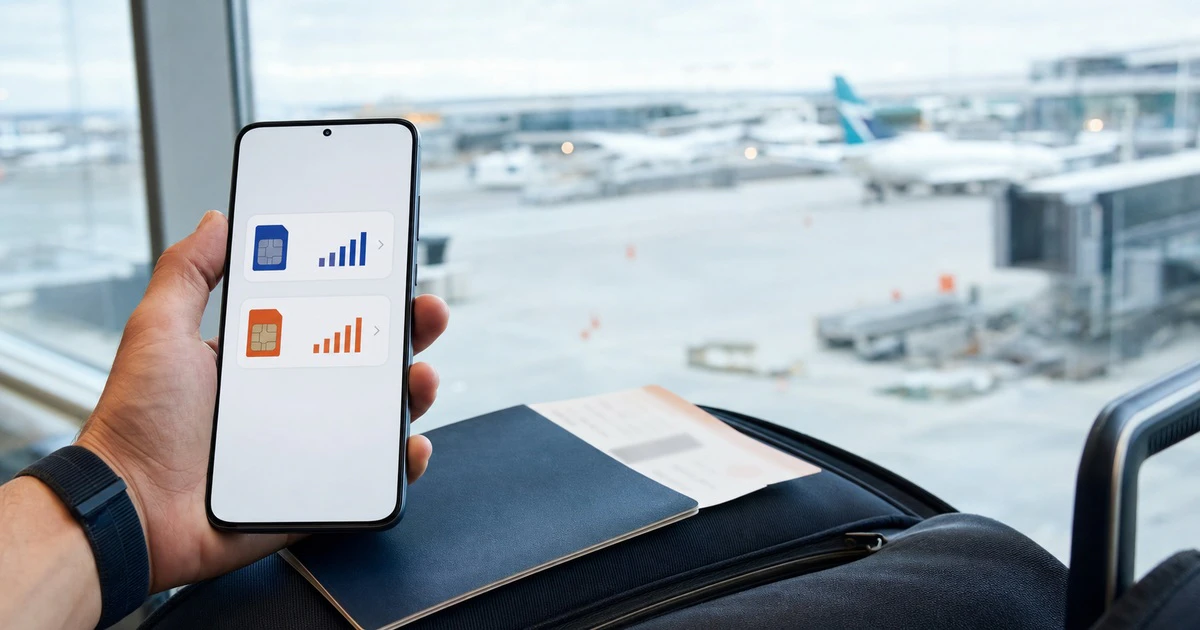
The easiest way to use your phone abroad is often the most expensive one.
Canadian carriers make roaming simple: arrive, use the phone and pay a daily fee or travel-pass price. A travel eSIM usually costs less for data, but it requires a few settings changes and may not include a normal phone number.
The better choice depends on the trip. Roaming sells convenience. A travel eSIM sells control.
What carrier roaming gives you
Roaming allows your Canadian SIM to connect to a partner network in another country. Eligible plans from Rogers, Bell and Telus can use a daily roaming feature or a prepaid travel pass.
The main benefit is continuity. Your Canadian number keeps working, contacts can call normally and your home-plan data may be available without installing another service.
The weakness is cost. A daily fee can become expensive across a long trip, especially when several family members have separate lines. A tiny amount of activity may trigger the day’s charge, depending on the carrier and plan.
Rates, destinations and included plans change. Check the carrier’s current page and the exact plan before leaving Canada. Do not assume a friend’s bill from last summer describes your account.
What a travel eSIM gives you
An eSIM is a digital SIM profile downloaded to a compatible phone. A travel provider can sell a data package for one country, a region or several destinations.
Most travel eSIMs are data-only. They give the phone internet access for maps, messaging apps, email and web browsing, but they may not include ordinary calls or SMS.
A dual-SIM phone can keep the Canadian line installed while using the travel eSIM for mobile data. That makes it possible to keep receiving some account-verification messages while avoiding home-line data roaming—but the settings must be correct.
Travel eSIM usually wins on longer trips
A travel eSIM is usually the better value when:
- the trip lasts more than a few days;
- you expect to use maps, translation and social apps often;
- several family members need data;
- the Canadian plan does not include the destination;
- you do not need a local phone number; and
- your phone is unlocked and supports eSIM.
Compare the total data allowance, length, supported networks, hotspot rules and whether “unlimited” service becomes slower after a daily limit. The cheapest plan is not useful when it connects to a weak network in the places you will visit.
Roaming can be worth paying for
Carrier roaming may be the better choice when:
- the trip is one or two days;
- your plan already includes the United States, Mexico or the destination;
- work needs the Canadian number to behave normally;
- you expect important ordinary calls or SMS messages;
- someone else is paying the bill; or
- you do not want to troubleshoot mobile settings while travelling.
Convenience has real value after a delayed flight or during an emergency. Saving money is not a victory if the phone cannot connect when it is needed.
A local SIM is a third option
A mobile carrier in the destination may offer an eSIM or physical SIM with local data, calls and a local number. This can be useful for a long stay, work, local deliveries or reservations that require a domestic phone number.
Local plans may require identification, registration or a store visit. Language barriers and unfamiliar terms can add friction. Check whether the plan renews automatically and whether it supports hotspot use.
Check the phone before buying
Confirm three things:
- The phone supports eSIM. Recent iPhones, Pixel phones and many Samsung Galaxy models do, but support varies by model and region.
- The phone is unlocked. A locked device may reject a second carrier.
- The phone supports dual SIM in the required combination. Some devices can store several eSIMs but keep only one or two active.
On an iPhone, open Settings > General > About and look for Carrier Lock. “No SIM restrictions” indicates that the phone is unlocked. Android wording varies by manufacturer and carrier.
If buying a new travel-friendly phone, Mapletechie’s Galaxy Z Fold 8 analysis makes a broader point that applies here: practical daily value matters more than an impressive feature list.
Install the eSIM before departure
Buy from a provider with clear support, refund and activation rules. Install the eSIM while connected to reliable home Wi-Fi, but read the instructions before activating it. Some plans start when installed; others start only when they first connect in the destination.
Give each line a clear label such as “Canada” and “Travel.” Save the provider’s support details somewhere available offline. If the eSIM uses a QR code, keep the code on another device or print it so the phone can scan it.
Use these settings to avoid accidental roaming
After arriving, set the travel eSIM as the mobile-data line. Turn data roaming on for the travel eSIM if its provider requires it.
On the Canadian line:
- turn data roaming off;
- disable automatic mobile-data switching;
- avoid answering or placing ordinary calls unless the cost is known;
- avoid sending SMS messages from the Canadian line unless the plan covers them; and
- check the carrier’s Wi-Fi Calling rules.
Keeping the Canadian line active can be useful for receiving verification texts, but activity that triggers a charge varies by carrier and destination. Rogers warns that some Wi-Fi calls or texts to non-Canadian numbers while travelling can still create roaming charges. “Wi-Fi” does not always mean “free.”
The safest option for someone who does not need the Canadian number is to turn that line off temporarily. The safest option for someone who must remain reachable is to read the carrier’s rules before the trip and budget for the necessary roaming.
Do not lose access to two-factor codes
Travel often triggers extra security checks from banks, email providers and social platforms. If those codes arrive by SMS, turning off the Canadian line may create a new problem.
Before leaving:
- move important accounts to an authenticator app or passkey where available;
- store recovery codes securely offline;
- confirm the bank’s travel and verification options; and
- test that the travel eSIM can connect before relying on it.
Do not make a major account-recovery change from an airport after the Canadian SIM has already stopped connecting.
Compare the complete cost
For roaming, multiply the daily fee by the number of chargeable days and lines. Check whether the fee has a billing-cycle cap and whether the destination is eligible.
For an eSIM, include the data package, taxes, possible top-ups and any calls or messages that still use the Canadian line. Check the exchange currency before paying.
A short trip may produce only a small difference. A two-week family holiday can turn a daily fee on several lines into a much larger bill.
The simple decision
Choose carrier roaming when the trip is short, the Canadian number must work normally or the plan already includes the destination.
Choose a travel eSIM when data is the main need, the trip is longer and the savings justify a few setup steps.
Choose a local SIM when staying long enough to need local calls, a local number and a domestic plan.
Whichever option you choose, set it up before the aircraft doors close. International roaming is a terrible subject to learn through a surprise phone bill.
Sources and further reading
- Apple guide to using eSIM while travelling
- Rogers roaming options
- Bell Roam Better information
- Telus travel and Easy Roam information
Tags: travel eSIM Canada, eSIM vs roaming, Canadian roaming fees, international phone data