Trump TV Isn’t News. That’s the Point.
Matthew Mbaka · September 22, 2026 · News
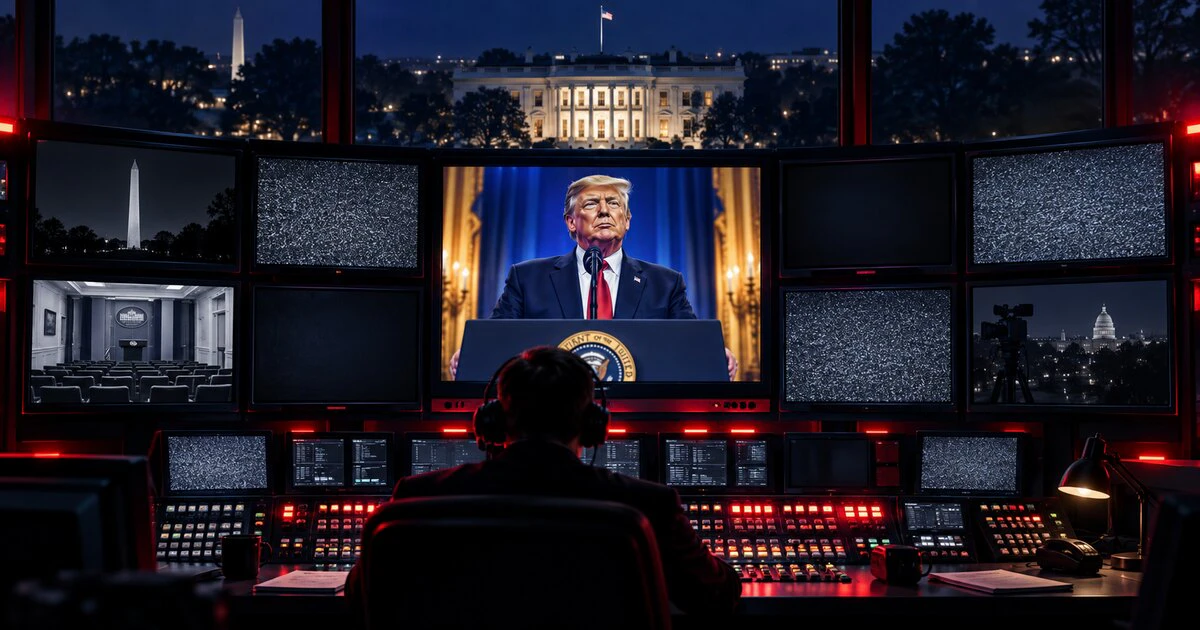
Donald Trump finally has the television channel his political brand always seemed destined to produce. Only this one sits inside the White House.
On Monday, September 21, the administration launched TRUMP TV: The Essentials Station, a 24/7 stream carried on YouTube and embedded on the White House website. The official pitch promises the administration’s “biggest moments,” major remarks and highlights, updated in real time.
That description matters. Trump TV is not a newsroom, and “24/7” does not mean 24 hours of new live reporting. The opening programming included a speech Trump delivered at Mount Rushmore on July 3, along with footage of his 2024 election victory and inauguration. Reuters reported that the stream had about 8,000 live viewers 15 minutes after launch.
https://x.com/WhiteHouse/status/2102172574822048160
The name is pure Trump: simple, personal and impossible to mistake for an institution that expects to outlive him. But the branding is the least interesting part.
The real story is the timing.
So, what is Trump TV?
The one-minute launch video is cut like a campaign trailer. It presents Trump’s return to office as a sequence of victories, applause lines and presidential imagery. There is no ambiguity about the product: this is an official highlight reel built to make the administration look good.
There is nothing technically unusual about a government publishing its own video. White houses, prime ministers’ offices, ministries and city halls have done that for years. Official feeds can be genuinely useful. They let people watch a full speech instead of relying on a ten-second television clip.
But an official feed and independent reporting do different jobs.
The government decides which event appears on its channel, where the camera points, what gets replayed, what gets trimmed and which uncomfortable moment never enters the playlist. A clip can be authentic and still leave viewers with a distorted picture through selection alone.
Calling Trump TV a television network would therefore give it too much credit. It is better understood as a permanent presidential communications channel: a press release with autoplay.
Why the timing matters
Three days before the launch, Trump announced that CNN, MS NOW and Politico would be barred from White House grounds, accusing them of publishing false reporting. Reporters from the organizations were subsequently denied access, and the outlets filed a federal lawsuit alleging violations of the First and Fifth Amendments.
The dispute then reached the machinery that supplies presidential video to broadcasters across the United States.
CNN is one of five organizations in the primary White House television pool, alongside ABC, CBS, Fox News and NBC. The outlets rotate responsibility for covering events in spaces where every broadcaster cannot fit, then share the resulting feed more widely. CNN was scheduled to handle Monday’s assignment but was prevented from doing so. The other networks responded by suspending pool coverage rather than replacing it.
That is why the sequence matters:
- Trump barred three news organizations from the White House.
- The television pool stopped covering designated presidential events.
- The White House launched its own 24/7 Trump-branded stream.
The administration says Trump TV gives the public direct access to its moments and announcements. Press-freedom advocates see something more troubling: an attempt to make government-selected footage the substitute for independent coverage.
The replacement was not even seamless. During Monday’s ribbon-cutting for a new White House helipad, the administration promoted its own livestream as an alternative to the pool feed. Reuters reported that the audio was inaudible.
That sounds like a minor production failure. It is actually a useful reminder. The press pool is not only a group of reporters asking questions. It is shared technical infrastructure built to capture, distribute and preserve presidential events even when access is limited. A government stream can copy the appearance of that infrastructure without copying its independence or reliability.
Real footage can still mislead
Trump TV will probably show plenty of genuine footage. That is not the same as giving viewers a complete account.
Imagine a channel that carries every ribbon-cutting, signing ceremony and standing ovation, but none of the unanswered questions, protests, corrections or policy failures surrounding them. Nothing on screen has to be fabricated. The editorial choice is the omission.
That distinction is important because “unfiltered” has become one of the internet’s favourite marketing words. Politicians say social media lets them speak without a hostile intermediary. Companies say livestreams let customers hear directly from executives. Influencers promise the version the media supposedly refuses to show.
Direct communication can remove one filter. It also installs another: the speaker’s own.
When watching an official government stream, three questions remain useful:
- Who chose this event or clip?
- What happened immediately before and after it?
- Could an independent reporter choose the camera angle and ask a follow-up question?
If the answer to the third question is no, the stream may still be informative. It is not a replacement for journalism.
It still depends on YouTube
Trump TV also contains a quieter technology story. Despite its grand name, the new station is not a standalone broadcast network. The White House is using YouTube for delivery and embedding that feed on its own site.
That is fast and inexpensive. It also places part of an official US government communications channel inside a commercial platform’s infrastructure.
YouTube controls stream availability, playback technology, recommendation systems, account enforcement and much of the audience data. The White House controls the programme, but not every layer between the video file and the viewer. If the feed fails, an account setting changes or YouTube alters how livestreams are surfaced, Trump TV is affected.
The arrangement is not unique. Governments routinely use private platforms because citizens are already there. Still, the branding can obscure the dependency. A channel can look like a sovereign media operation while running on someone else’s servers, player and rules.
Why this matters in Canada
This is not only an American press-freedom argument. Any Canadian government could assemble the same product quickly: a YouTube livestream, a rotating archive, a first-party webpage and social posts directing supporters to it.
The difficult questions would not be technical. They would concern access, public money, archiving, corrections and whether official footage was being offered alongside independent coverage or used to squeeze it out.
A prime minister’s livestream can help Canadians watch an announcement in full. It should not become the only practical source of moving images from that announcement. Once a government controls the room, the guest list, the camera, the edit and the archive, “direct access” starts to mean access on the government’s terms.
That is the lesson worth carrying north. Official media is useful as a primary source. It becomes dangerous when it is presented as sufficient on its own.
What we still don’t know
The White House live page says Trump TV will run around the clock and be updated in real time. The launch materials reviewed by Mapletechie do not explain its budget, staffing, editorial approval process, correction policy or long-term archive.
Those are not boring administrative details. They determine what kind of institution the White House is building.
- Will the station carry full events or mostly favourable excerpts?
- Will it show live presidential appearances when independent pool cameras are absent?
- Who decides what counts as an “essential” Trump moment?
- Will edited videos disclose what was removed?
- Will mistakes receive visible corrections?
- Will the archive remain intact after this administration leaves office?
- How much public money, staff time and promotional infrastructure support it?
The court fight may answer the more immediate question of whether CNN, MS NOW and Politico regain access. It will not resolve the broader shift Trump TV represents.
A government no longer needs its own television network to run a channel like this. It needs a streaming account, a library of official footage and staff to keep the feed updated. The more important question is how that channel is used when independent media access is restricted.
The bottom line
Trump TV gives the White House a permanent place to distribute its preferred version of events. It is easy to share, available around the clock and built entirely from material the administration chooses.
That does not make the footage useless. Full speeches and official announcements can help viewers see more than a short television clip. But the White House still decides which events appear, where the camera points, what gets replayed and what is left out.
The timing is what makes this launch important. Trump TV arrived days after the administration barred CNN, MS NOW and Politico from the White House and the major television networks suspended pool coverage. If independent cameras remain absent from some events, the administration’s own feed could become the main source of video from inside the White House.
Viewers should therefore treat Trump TV as an official government source, not as an independent news service. It can show what the administration wants the public to see. Reporters are still needed to ask questions, verify claims and cover what does not appear on the channel.
Sources: White House launch video; White House stream page; Reuters; Associated Press.
Tags: Trump TV, Donald Trump, White House, YouTube, press freedom, media