Ukraine's Moscow Drone Wave Tests the Cost of Air Defence
Matthew Mbaka · September 21, 2026 · News
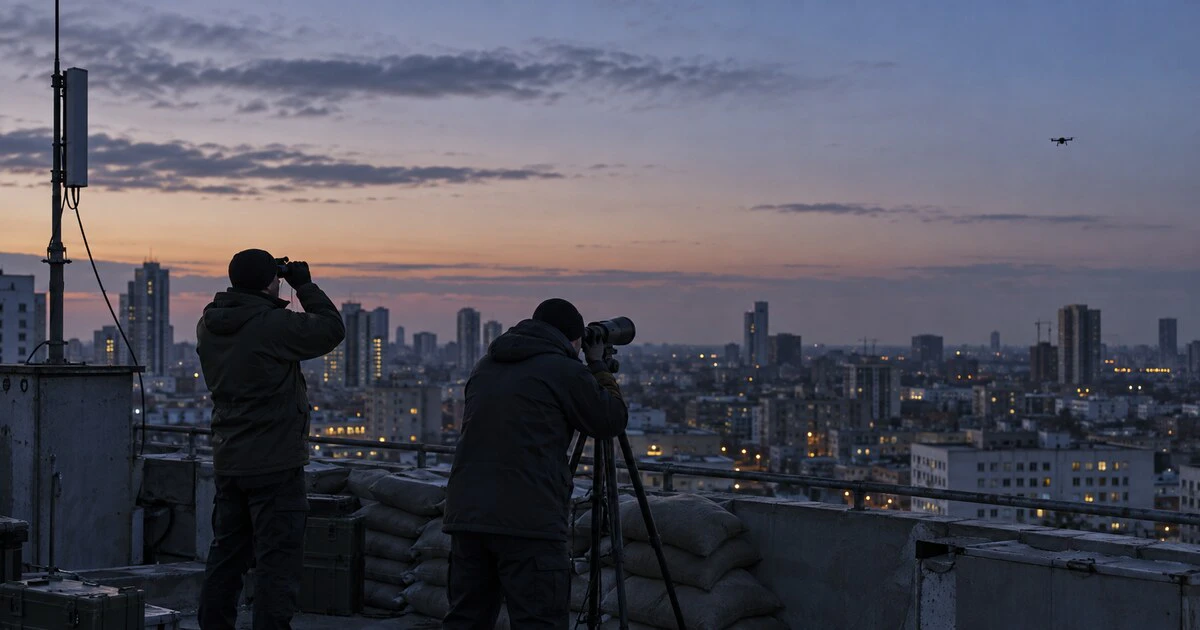
Russia says Ukraine sent hundreds of drones toward Moscow during a much larger attack across the country on September 20. The totals are difficult to verify, but the scale points to a problem every air-defence planner now faces: stopping one drone is very different from stopping hundreds over and over again.
Moscow Mayor Sergei Sobyanin said 450 drones were headed for the capital. Russia's defence ministry said it destroyed 1,110 drones across Russia, occupied Crimea and the Black Sea overnight. The Associated Press reported the figures while noting damage to the Moscow oil refinery and a residential building.
Reuters witnesses heard explosions and saw smoke from the refinery. Two people were reported killed in the Moscow region, 20 were injured and 400 residents were evacuated from one apartment building.
The headline number is not a performance score
Russian authorities described the attack as the largest yet on Moscow and said most of the drones were intercepted. Those claims have not been independently verified. The public numbers also do not reveal how many decoys were involved, which weapons were used, or whether drones failed before reaching defended airspace.
That missing information matters. A defence system can report a high interception rate and still fail if a few drones reach an oil refinery, power station or residential area. Debris from successful interceptions can also cause harm over a dense city.
Mass attacks force expensive choices
A city cannot use its most expensive interceptor on every small target indefinitely. It needs layers.
Detection: Radar alone may struggle with small, low-flying objects in cluttered urban terrain. Optical, acoustic and radio-frequency sensors can fill gaps, but they create more data to combine.
Identification: Defenders have little time to decide whether an object is hostile, harmless or a decoy. A false positive can waste an interceptor or endanger civil aviation.
Response: Electronic warfare, guns, interceptor drones and missiles each work in different conditions. No single method covers every altitude, speed and guidance system.
Capacity: Launchers, crews and ammunition must still be available for the next wave. A successful night can leave a city less protected the following day.
The attacker gets to probe that system. It can vary routes, timing and target types, or mix drones with missiles. Defence becomes a contest in manufacturing and logistics as much as one of radar performance.
What Canada should take from it
Canada does not face Moscow's immediate conditions, and the countries' geography is very different. Still, the attack is relevant to Canadian planning for airports, military bases, ports, power systems and northern infrastructure.
Procurement discussions often focus on the interceptor. The harder work is building the whole chain: sensors that see small targets, communications that keep working, clear authority to act, enough low-cost responses, and crews trained to operate around civilian aircraft and neighbourhoods.
Mapletechie recently looked at how the Iran war is changing American military-technology buying. The same lesson appears here. Defence departments need deep stocks and systems they can afford to use repeatedly, not only exquisite weapons that perform well in a demonstration.
The September 20 totals may change as more evidence appears. The central point will not: a mass drone raid turns air defence into an endurance problem.
Tags: Ukraine, drones, air defence, defence technology, Canada