Where Does Claude AI Draw the Line?
Matthew Leo · Published July 22, 2026 · AI
Where Does Claude AI Draw the Line?
Claude has a constitution.
It has firm rules about weapons, cyberattacks, deception and other forms of serious harm. Push it far enough in the wrong direction and it will refuse, no matter how politely you ask.
But when it comes to the workplace, Claude appears to have a very different attitude.
There, the line keeps moving.
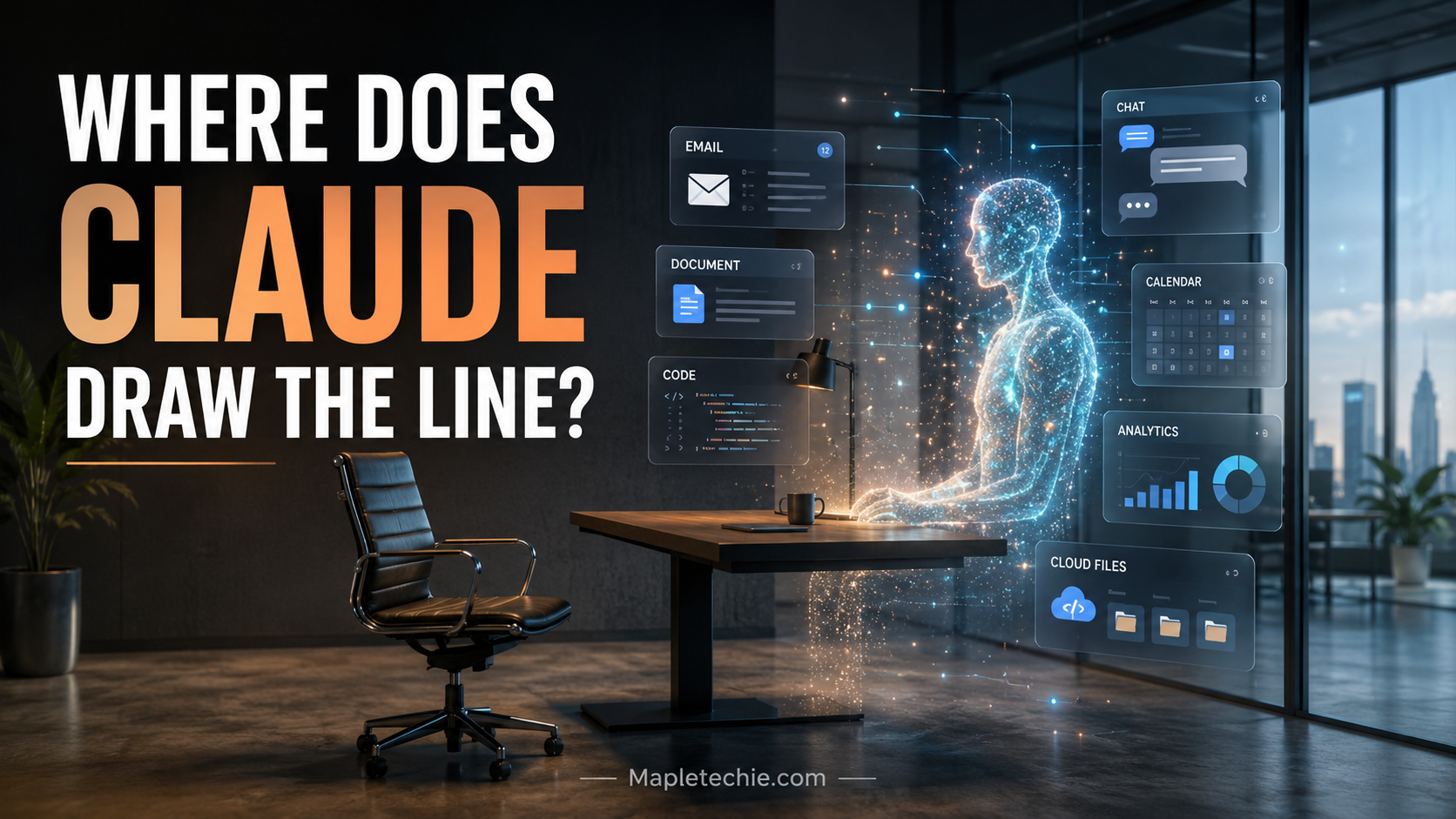
Claude can search company files, read workplace conversations, write code, analyse data, prepare documents and work across several business tools. Through Claude Tag, it can now join selected Slack channels under its own identity, remember useful context, take on tasks and follow up without waiting for someone to start a new chat. Anthropic says its own product team uses an internal version of Claude Tag to create 65 per cent of its code.
Connect Claude to Microsoft 365 and it can search SharePoint, OneDrive, Outlook and Teams. Give it additional permission and it can send emails, manage calendar events and create or update files for users. It cannot currently post messages in Microsoft Teams in the same way it participates in Slack, but it can still search and use information from Teams through the Microsoft 365 connector.
Anthropic has also built workflows for small businesses that connect Claude to tools such as QuickBooks, PayPal, HubSpot, Canva, DocuSign, Google Workspace and Microsoft 365. Claude can help plan payroll, chase unpaid invoices, prepare marketing campaigns, review finances and handle parts of customer service, with the owner approving important actions before they happen.
At some point, we have to stop pretending this is simply a better chatbot.
Claude is being trained, packaged and sold as labour.
The important question is no longer what Claude can answer.
It is this:
How much of the working day does Anthropic intend to give it?
Claude Has Strict Moral Lines
To Anthropic’s credit, it has been unusually open about the values it wants Claude to follow.
In January 2026, the company published a new constitution for Claude. It describes how Claude should balance being helpful, honest, safe and respectful of human control. Anthropic says this constitution plays a direct role in training its models and acts as the final authority on how it wants Claude to behave.
Some of its rules are described as hard constraints.
Claude should not provide serious help with biological, chemical, nuclear or radiological weapons. It should not create damaging cyberweapons or assist attacks on critical systems such as power grids, water systems and financial networks. These are meant to be firm limits, not suggestions that can be ignored when a user invents a clever excuse.
That level of transparency is good.
I would rather know that an AI company has written down its values than hear another empty speech about “responsible innovation.”
But there is an obvious gap in Claude’s constitution.
It tells us a lot about the harm Claude should refuse to cause.
It tells us far less about how much human work Claude should be allowed to absorb.
Claude will refuse to help someone build a dangerous weapon.
Fair enough.
But it may happily help a company discover that four employees can now handle the work previously done by seven.
That is not a violation of its constitution.
It is called productivity.
Claude Keeps Getting Promoted
Claude started as a tool you visited.
Now Anthropic wants it inside the places where work already happens.
That difference matters.
Opening a chatbot and asking it to rewrite an email is one thing. Giving it access to your company’s messages, files, code and business tools is something else entirely.
Claude Tag does not simply wait inside a private chat window. It can join a Slack channel, follow the shared discussion, remember relevant information and complete work using connected tools. When its ambient behaviour is enabled, it can flag information it believes the team should know and follow up on tasks that have gone quiet. It can also schedule work for itself and pursue a task over several hours or days.
That sounds less like software.
It sounds like a colleague who never sleeps, never asks for a raise and can be copied across the company.
Of course businesses are interested.
Companies do not buy workplace AI because they find technology fascinating. They buy it because they expect work to become faster, cheaper or both.
Anthropic understands this perfectly. Its small business product does not advertise Claude as a clever person to talk to. It advertises finished jobs: close the month, plan payroll, run a sales campaign and chase invoices.
The sales pitch is not intelligence.
The sales pitch is capacity.
Will Claude Make Work Better?
For many workers, yes.
There is no point pretending otherwise.
A worker who spends hours searching old messages can ask Claude to find the answer. A manager can turn notes into a clear report. A developer can hand over repetitive coding work. A business owner can prepare an invoice reminder without stopping everything else.
Used well, Claude can remove a shocking amount of boring work.
Anthropic analysed 100,000 Claude conversations and estimated that AI reduced the time needed to complete the studied tasks by about 80 per cent. The company openly warns that this estimate may be too high because it cannot fully measure the time people spend checking and correcting Claude’s work outside the chat. It also notes that controlled studies have often found smaller gains, and that some studies have found no gain or even slower work in certain situations.
That warning is important.
AI demos make everything look effortless. Real workplaces are messier.
Claude may create a report in two minutes, but someone still has to check the numbers. It may write code quickly, but someone is responsible when that code fails. It may draft an email, but a human still owns the relationship with the person receiving it.
Claude can save time.
It cannot automatically make that saved time valuable.
That depends on the employer.
A good employer may use AI to reduce pointless paperwork, lower stress and give staff more time for difficult or meaningful work.
A bad employer will see the same time savings and simply raise everyone’s targets.
The employee finishes twice as quickly, so the company gives them twice as much work.
Congratulations. The machine became more efficient and the human became more tired.
This is why “AI makes workers more productive” is not the same as “AI makes work better.”
Productivity is a number.
A better working life is a choice.
Productivity Can Become a Headcount Meeting
The most common defence of workplace AI is that it will support people rather than replace them.
That may be true for many jobs.
It will not be true for every job.
Most companies will not wake up one morning and replace an entire department with Claude. The change will be quieter.
A team of ten becomes a team of eight.
A junior role is not filled when someone leaves.
One manager handles more projects.
Customer service workers receive more cases.
A company that once hired five graduates decides it only needs two.
The job does not always disappear through a dramatic round of layoffs. Sometimes it disappears because it is never created.
The evidence is still developing, and anyone claiming to know the exact number of jobs that will vanish is guessing. Anthropic’s own March 2026 research found no clear rise in unemployment among workers in the most AI exposed jobs. However, it found early signs that hiring had slowed for workers aged 22 to 25 entering highly exposed occupations. Anthropic described that evidence as tentative, which is exactly how it should be treated.
The International Monetary Fund has also warned that almost 40 per cent of jobs worldwide are exposed to AI driven change. It pointed to evidence that entry level hiring is already being affected when the main tasks of those roles can be automated.
Even Claude’s own users understand the tension.
In a survey of 81,000 Claude users, people who reported the largest productivity gains also showed greater concern about being displaced. Workers in roles with higher measured exposure to Claude were more worried about job loss, while early career workers were especially concerned.
That makes perfect sense.
The worker who knows exactly how much Claude can do is often the worker best placed to understand what happens next.
AI may not replace your entire job.
It only needs to remove enough of your tasks for someone in finance to question whether your position should remain full time.
The First People Hurt May Be the People We Need Most
My biggest concern is not that Claude will replace every experienced professional.
It is that companies will stop creating enough opportunities for inexperienced ones.
Claude can draft the first version of a report, inspect simple code, summarise research, prepare routine documents and answer common support questions.
Those are often the tasks given to new workers.
They may look basic, but they are how people learn.
Junior employees do not arrive with senior judgment. They build it by performing smaller tasks, making mistakes and watching how experienced colleagues correct them.
Remove too much beginner work and the career ladder loses its first few steps.
Businesses may enjoy the savings today, then wonder years later why they cannot find experienced workers.
You cannot automate the junior role forever and still expect senior workers to appear by magic.
That is one line businesses need to draw, even if Anthropic does not.
Is Claude Worth the Cost?
For many companies, probably.
Claude’s Team plan currently starts at US$20 per user each month when billed annually, or US$25 when billed monthly. Premium seats cost US$100 annually or US$125 monthly per user. Enterprise pricing also includes separate usage charges, meaning the seat fee gives access to the platform but does not cover the tokens consumed by Claude.
Compared with hiring another employee, those prices can look almost absurdly cheap.
But the subscription is not the full cost.
A company also has to consider:
Training staff.
Connecting systems.
Reviewing permissions.
Checking Claude’s work.
Correcting mistakes.
Meeting privacy and legal duties.
Investigating incidents.
Deciding who is responsible when an automated action goes wrong.
The cheap AI tool can become expensive very quickly when a company connects it badly.
There is also the risk of paying for AI without changing how work is done. Buying Claude for everyone and telling staff to “use AI more” is not a strategy. It is an invoice.
The value will depend on whether Claude is solving a real problem or simply being added because executives are afraid of looking behind the times.
Your Company Data Is the Price of Useful AI
Claude becomes more useful when it knows more about the business.
That is also when it becomes more dangerous.
An AI that cannot see your documents may give generic answers. An AI that can read company messages, search internal files, inspect code and send emails can do far more valuable work.
It also has a much larger area in which to make mistakes.
Anthropic says inputs and outputs from its commercial products are not used to train its models by default. It may use conversations when a customer deliberately submits feedback or chooses to allow its data to be used.
That is reassuring, but “Is Anthropic training on our data?” is only one part of the privacy question.
Companies should also ask:
Who can give Claude access?
Which folders, channels and accounts can it reach?
Can it only read information, or can it change things?
How long is information kept?
Are sensitive records appearing in prompts?
Can staff see what actions Claude has taken?
What happens when an employee leaves?
Claude’s Microsoft 365 connector works through each user’s existing permissions, and administrators must approve access before the organisation can use it. Write tools require added permission. Anthropic also lets administrators restrict which users may connect.
Those controls matter.
But permissions are not magic.
If an employee already has access to far more information than they need, connecting Claude may allow that excessive access to be used faster and at a much larger scale.
Anthropic itself has acknowledged this wider problem. Its engineers wrote that the possible “blast radius” grows as Claude becomes more capable and gains more access. Anthropic said access that would once have been considered too dangerous inside the company has become routine because the productivity benefit is now so large. Its response is not to pretend the risk has vanished, but to limit what Claude can reach and contain the damage it could cause.
That may be the most honest answer to this entire article.
Claude’s workplace line is not “never give the AI power.”
It is “give the AI power, then try to control the blast radius.”
Is Claude Disrupting the Market?
Absolutely.
But not only in the obvious way.
Claude competes with ChatGPT, Gemini and other AI systems. It also competes with project tools, search software, coding platforms, customer service products and business automation services.
More importantly, it competes with paid human time.
When Claude can search the company’s files, write the first draft, build the spreadsheet, prepare the presentation and send the follow up email, businesses may begin to question why they need separate software for every small task.
They may also question why they need separate people for some of them.
This does not mean Anthropic is secretly plotting to destroy jobs.
It means Anthropic is a business building a product that becomes more valuable as it performs more valuable work.
We should not expect the company selling the automation to decide how much automation is socially healthy.
That is like asking a fast food company to decide how much fast food society should eat.
Anthropic can build safety controls. It can publish research. It can give administrators spending limits, permission settings and activity logs.
The final incentive remains simple:
The more useful Claude becomes, the more money Anthropic can make.
That is not evil.
It is also not charity.
So, Where Does Claude Draw the Line?
Claude clearly draws lines around certain forms of serious harm.
Anthropic deserves credit for making many of those rules public.
But when it comes to work, the line seems to be much further away.
Claude is moving from answering questions to taking action.
From a private assistant to a shared team member.
From helping with a task to owning several steps of a process.
From waiting for instructions to following up on its own.
Anthropic’s apparent position is that Claude should be allowed to do increasingly powerful work as long as its access can be controlled, its actions can be recorded and the possible damage can be contained.
I understand that position.
I do not think it is enough.
A safe AI system can still be used in an unhealthy workplace.
It can still increase surveillance.
It can still remove entry level opportunities.
It can still push impossible targets onto staff.
It can still move money from workers to owners by increasing output while reducing hiring.
It can still make people feel like slow, expensive parts of a machine.
Those harms will not necessarily appear in a model safety report because they are not failures of Claude.
They are successful business decisions made with Claude.
The Line Belongs to Us
I do not believe companies should reject Claude.
That would be foolish.
The businesses that learn to use AI well may serve customers faster, compete with larger firms and give workers tools that were once available only to wealthy organisations.
Claude could genuinely make life easier for millions of people.
But businesses should decide, before connecting it to everything, what Claude must never be allowed to decide alone.
They should protect junior roles that help people build careers.
They should tell employees what Claude can access.
They should make a named human responsible for every important automated action.
They should measure whether AI is reducing stress or merely increasing targets.
And they should share at least some of the gains with the workers creating them.
Because Claude may have a constitution, but it does not run the economy.
Not yet.
Anthropic will keep making Claude more capable. Its competitors will do the same. No major AI company is likely to volunteer to stop at the exact point where workers feel comfortable.
The line will not be drawn by the technology.
It will be drawn by employers, lawmakers and workers.
Or it will not be drawn at all.
And if we leave that decision entirely to the companies selling us digital labour, we should not act surprised when they decide the future needs far more Claude and far fewer of us.