Wildfire Smoke: Build a Cleaner-Air Room at Home
Matthew Leo · Published August 3, 2026 · Guides
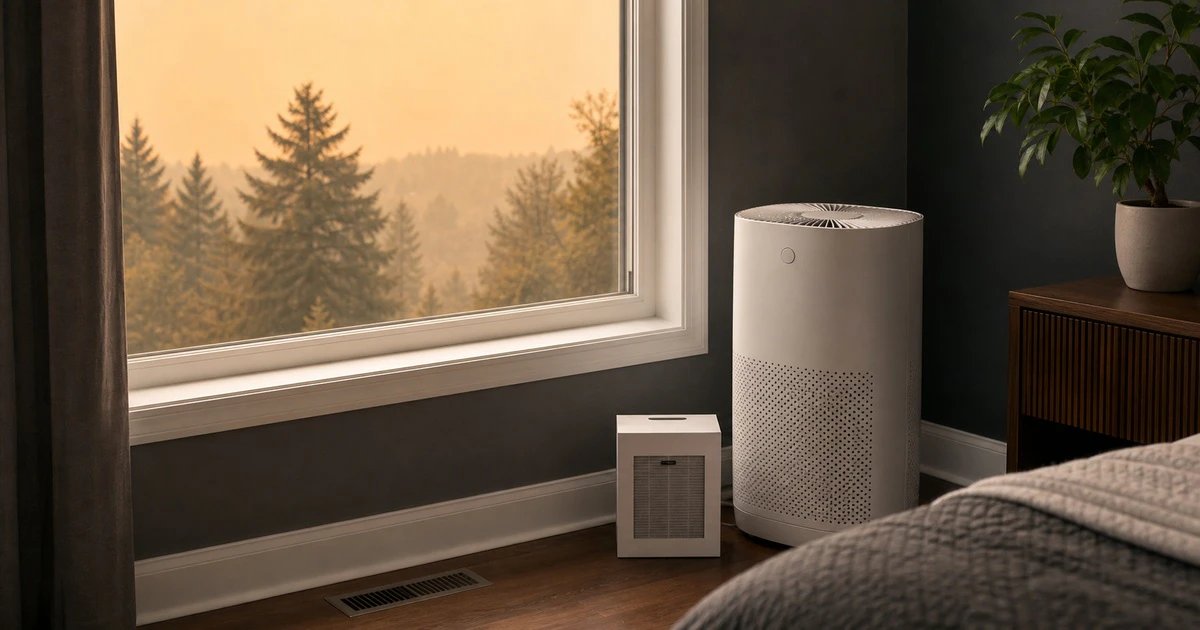
During wildfire smoke, the safest room is the one you can keep cool, closed and continuously filtered.
Smoke can travel hundreds or thousands of kilometres. A community does not need to be near flames for fine particles to enter homes and affect breathing.
A “cleaner-air room” gives a household one place with lower smoke levels. It does not require rebuilding the home. It requires choosing the right room, limiting smoky outdoor air and moving enough indoor air through an effective filter.
Check the AQHI before you smell smoke
The smell of smoke is not a reliable measurement. Fine particles can be harmful before the air looks dramatic, and a familiar smell may fade even while pollution remains.
Canada’s Air Quality Health Index reports health risk on a scale from 1 to 10+. Values from 1 to 3 are low risk, 4 to 6 are moderate, 7 to 10 are high and 10+ is very high.
During heavy wildfire smoke, the AQHI may be calculated from fine-particle levels so it can respond more quickly. The WeatherCAN app can show local AQHI readings and send custom air-quality notifications.
Set an alert before smoke arrives. That creates time to close the home, install a clean filter and move a purifier into the chosen room.
Choose one room first
Trying to clean an entire house with one small purifier usually produces disappointing results.
Choose a bedroom or living room where people can spend several hours. The room should have:
- a door that closes;
- few outside doors or leaky windows;
- enough space for the household members who need it;
- access to power without an extension cord; and
- a way to remain cool during hot weather.
People with asthma, heart or lung conditions, older adults, pregnant people, children and anyone working outdoors may be more affected by smoke. Place the cleaner-air room where the most vulnerable person can use it easily.
Keep smoke out without trapping dangerous heat
Close windows and doors when outdoor smoke is heavy. Set a suitable air conditioner to recirculate indoor air when possible, and limit bathroom or kitchen exhaust fans that pull replacement air through gaps in the building.
Do not seal a room so aggressively that it becomes dangerously hot. Health Canada says staying cool takes priority when extreme heat and smoke happen together. If the home cannot remain safe with windows closed, use a public cleaner-air or cooling space.
When outdoor air improves, opening the home can help remove indoor pollutants. Watch current conditions rather than following one setting for an entire week.
Buy the purifier for the room, not the house
A portable air cleaner should be sized for the room where it will operate.
Look for the smoke clean-air delivery rate, usually called smoke CADR. Health Canada recommends choosing a device with a tobacco-smoke CADR of at least two-thirds of the room’s area in square feet.
For example, a 12-by-15-foot room has an area of 180 square feet. Two-thirds of 180 is 120, so the purifier should have a smoke CADR of at least 120. A larger rating can clean the air faster or allow the fan to run at a quieter setting.
Room-size claims normally assume an eight-foot ceiling. A room with a high ceiling contains more air and may need a larger purifier.
HEPA matters more than smart features
Wildfire smoke contains PM2.5: particles small enough to travel deep into the lungs. A certified portable cleaner with an effective particle filter can reduce those particles indoors.
Prioritize:
- an adequate smoke CADR;
- readily available replacement filters;
- a noise level people will tolerate overnight;
- a sealed design that does not leak air around the filter; and
- low power use if it will run for days.
Wi-Fi controls, colourful air-quality rings and an app can be convenient. They do not compensate for a purifier that is too small.
Avoid ozone generators. Health Canada warns that ozone sold as an indoor-air treatment can harm health. Be cautious with ionizing or electrostatic features unless the unit has been independently tested to produce little or no ozone.
Run the purifier continuously
A purifier only cleans air while moving air through its filter.
Run it before smoke becomes severe, keep doors and windows closed, and use the highest fan speed the room can tolerate. Lower the speed for sleep if noise would otherwise make someone turn it off.
Place the unit where air can reach the intake and leave the outlet freely. Do not press it against a wall, hide it behind a couch or cover it with clothing.
Check the filter during a long smoke event. A filter can become dirty faster than its normal replacement schedule suggests. Keep at least one replacement on hand before local stores sell out.
A DIY cleaner can help in an emergency
A box fan attached to a high-efficiency furnace filter can reduce particles when a commercial purifier is unavailable or unaffordable. Health Canada describes DIY cleaners as a short-term emergency option and gives important safety limits.
Use a clean, certified box fan made in 2012 or later with a safety fuse. Use a suitable high-efficiency filter, keep the fan away from curtains and furniture, and replace the filter when it becomes dirty.
Never leave the fan running unattended or while everyone is asleep. Do not use a damaged fan or an extension cord, and do not leave children alone with it.
A multi-filter cube or wedge can move more air than one filter pressed against a fan, but every design still needs stable construction and safe clearance.
Use the home’s main filter carefully
A central forced-air system can help, but the highest-numbered filter is not automatically safe for every furnace or air handler.
Health Canada recommends using the highest-quality filter the system can handle, based on the manufacturer’s instructions. Higher-efficiency filters, including MERV 13 where compatible, capture more fine smoke particles.
A filter that restricts too much airflow can strain an unsuitable system. Ask an HVAC technician when the correct rating is unclear. Keep spare filters because heavy smoke can load them quickly.
Do not create more particles indoors
During a smoke event, avoid smoking, burning candles, using a wood-burning appliance and frying or broiling food when possible. Limit vacuuming unless the machine has an effective HEPA filter, because cleaning can put settled particles back into the air.
Wet wiping and mopping are better ways to remove settled dust. A working carbon-monoxide alarm is also important when doors and windows remain closed and combustion appliances are present.
Prepare before the alert
- Choose the cleaner-air room.
- Measure it and calculate the minimum smoke CADR.
- Buy or test the purifier.
- Store at least one replacement filter.
- Check the central-system filter and recirculation setting.
- Install WeatherCAN and set an AQHI alert.
- Find the nearest public cleaner-air or cooling space.
- Make a plan for pets, medication and anyone at higher risk.
Mapletechie’s practical technology guides focus on the same principle: a simple system tested before an emergency is more useful than expensive equipment opened for the first time during one.
Clean air is the feature that matters
Do not buy an air purifier because the app has an attractive graph. Buy it because the filter is suitable for smoke, the airflow matches the room and replacement filters will still be available next summer.
Close the room, keep it cool, run the cleaner and watch the AQHI. That combination matters far more than the logo on the machine.
Sources and further reading
- Health Canada wildfire-smoke protection guidance
- Health Canada portable air-cleaner guide
- Environment Canada AQHI guide
- WeatherCAN app information
Tags: wildfire smoke air purifier, cleaner air room, HEPA filter Canada, AQHI