Drone Detection Is Legal. Jamming Usually Isn’t
Matthew Leo · Published October 23, 2026 · Guides
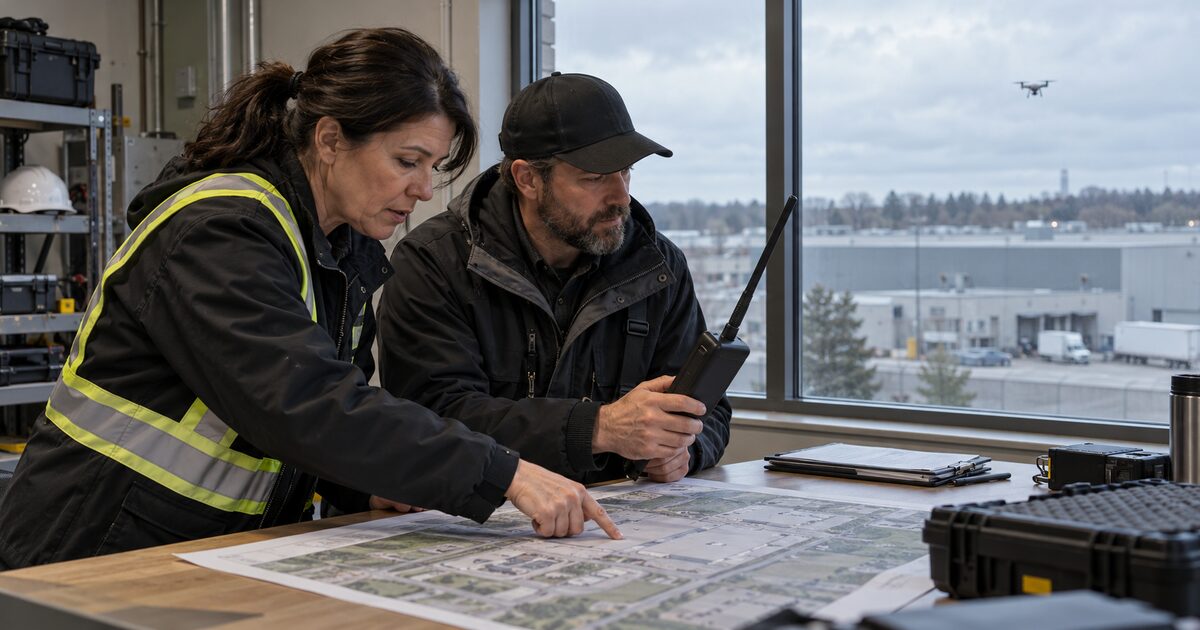
European governments are giving more critical-infrastructure operators power to stop hostile drones. Canadian organizations should not assume the same tools are legal here.
Reuters reported on October 21 that France now allows approved operators and contractors at some vital sites to detect, jam or bring down drones, while Germany, Austria and Poland are considering or revising similar powers. France’s authority comes from a law adopted in August.
The change reflects a real security problem, but it does not travel across borders. In Canada, the practical line is much sharper: passive detection can be lawful, while transmitting interference is generally prohibited.
Detection and neutralization are different jobs
Counter-drone products are often marketed as one category, even though they do very different things.
Passive detection listens for radio signals or uses cameras, radar or acoustic sensors to identify and track an object.
Jamming transmits radio energy intended to disrupt the drone’s control or navigation links.
Spoofing sends false signals intended to mislead a receiver.
Physical interception tries to capture, strike or otherwise disable the aircraft.
Each carries different legal and safety risks. A sensor that alerts a security team is not equivalent to a transmitter that can affect nearby communications or navigation.
Canada’s rule on radio jammers is direct
Innovation, Science and Economic Development Canada says jammers are prohibited in Canada. The department specifically treats radio-frequency counter-drone and spoofing equipment as jammers. Importing, manufacturing, distributing, offering for sale, selling, possessing and using these devices is prohibited unless a ministerial exemption applies.
A facility cannot create its own emergency exception because a drone seems suspicious. Interference may affect cellular service, satellite navigation, public-safety communications or equipment outside the property. Attempting to shoot or capture an aircraft can create separate aviation, firearms, property and liability risks.
This is general information, not legal advice. Organizations considering any counter-drone system should obtain advice specific to the site, its regulator and the technology involved.
A safer response plan for Canadian sites
1. Define the threat before buying equipment
Document what needs protection, likely approach paths, nearby airports and the consequences of a false alarm. A prison, airport, power station and event venue do not have the same risk profile.
2. Start with passive awareness
Choose detection tools that do not transmit disruptive signals. Ask vendors to identify every radio component, operating frequency, licence requirement and data source. “Non-kinetic” does not automatically mean passive or lawful.
3. Build an escalation path
Decide who verifies an alert, who contacts police or aviation authorities and who can pause operations. Record times, sensor observations and photographs without approaching the aircraft or suspected operator.
4. Protect privacy
Cameras and radio sensors can collect information about workers, visitors and neighbours. Set retention periods, access controls and a clear operational purpose before deployment.
5. Exercise the plan
Run tabletop drills for an unidentified drone, a false positive and a drone crash. Include communications, evacuation decisions and evidence preservation.
Questions to put to a counter-drone vendor
Does any component transmit, interfere with or imitate radio or navigation signals?
Which Canadian authorization supports its use at this site?
How does the system distinguish drones from birds, aircraft and background radio traffic?
What happens when the product cannot identify a drone’s operator or intent?
Where are sensor logs stored, and who can access them?
Mapletechie’s earlier analysis of drone attacks and the cost of air defence shows why governments want more options. The Canadian takeaway is narrower: detect, document and coordinate first. Do not turn a security concern into a spectrum or public-safety incident with an unauthorized jammer.
Tags: drones, spectrum, security, critical infrastructure, Canada