Germany Is Moving to Co-Produce Ukraine’s New Drones
Matthew Leo · Published October 9, 2026 · Business & Policy
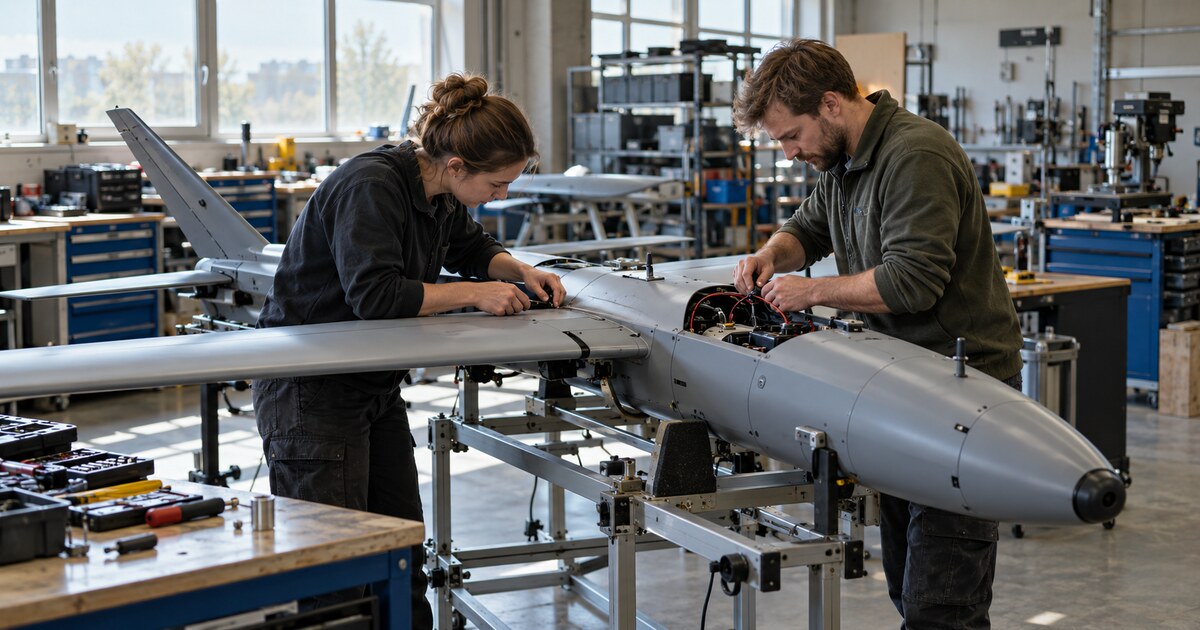
Germany and Ukraine are preparing a wider agreement to produce drones, missiles and related software together. The important part is not another shipment of finished equipment. It is the attempt to turn Ukrainian battlefield designs into a European production system.
German Chancellor Friedrich Merz arrived in Kyiv on October 4 with Economy Minister Katherina Reiche and executives from Siemens Energy, Hensoldt, Diehl Defence and Quantum Systems. German officials told Reuters that a joint drone-production deal was due to be finalized during the visit. Merz also announced plans to release €1 billion in military aid and €350 million for repairs to Ukraine’s damaged energy system.
The public details remain incomplete. No final agreement, production volume or delivery schedule was available when this article was prepared.
The new part is scale and shared production
German-Ukrainian drone manufacturing is not starting from zero. In April, the Ukrainian presidency said memoranda had already been signed around seven Ukrainian systems. One joint venture involving Quantum Systems and Frontline Robotics planned to manufacture at least 10,000 Linsa 3.0 drones in Germany during 2026.
The current negotiations appear broader. Ukrainian President Volodymyr Zelenskyy said the countries were working on drones, missiles and software. Reuters reported that rapidly producing anti-jet drones tested by Quantum Systems was expected to be a focus.
That distinction matters because Russia has increasingly used faster jet-powered attack drones. A low-cost interceptor that can be built in quantity could fill the gap between electronic warfare, guns and expensive surface-to-air missiles. It is not a universal answer: detection, guidance, weather performance and the ability to distinguish targets still decide whether an interceptor is useful.
Germany wants the technology to move both ways
Merz described the partnership as beneficial to both countries. Ukraine contributes designs shaped by repeated combat use. German firms contribute industrial equipment, capital, quality control and access to a larger European supply chain.
The arrangement could also shorten the slow procurement cycle that often separates a battlefield need from a conventional defence contract. The risk is that scaling too quickly can freeze an immature design, create dependence on a single supplier or expose sensitive software and production knowledge.
The Associated Press independently confirmed Merz’s Kyiv visit and his emphasis on companies jointly developing technology. It did not provide the final terms of the production agreement.
What Canada should watch
Canada is not a party to this deal, and there is no evidence that Ottawa plans to buy the systems being discussed. The model is still relevant to Canadian defence procurement.
Canada has supported Ukraine while trying to expand domestic ammunition, drone and sensor capacity. A useful agreement would secure more than delivery slots. It would define who can modify the software, where replacement parts are made, how quickly the design can change after field lessons and whether Canadian firms can maintain the system without waiting for a foreign contractor.
Mapletechie previously examined why mass drone attacks turn air defence into a cost and capacity problem. Joint production is one answer to that problem, but the test will be output: how many working systems are delivered, how quickly designs improve and whether inexpensive interceptors perform outside controlled demonstrations.
Until the signed terms are published, claims about production volume or combat performance should be treated as pending rather than settled.
Tags: Ukraine, drone manufacturing, air defence, Quantum Systems