The Pentagon Wants More Small Drone Boats at the Border
Matthew Leo · Published October 4, 2026 · Business & Policy
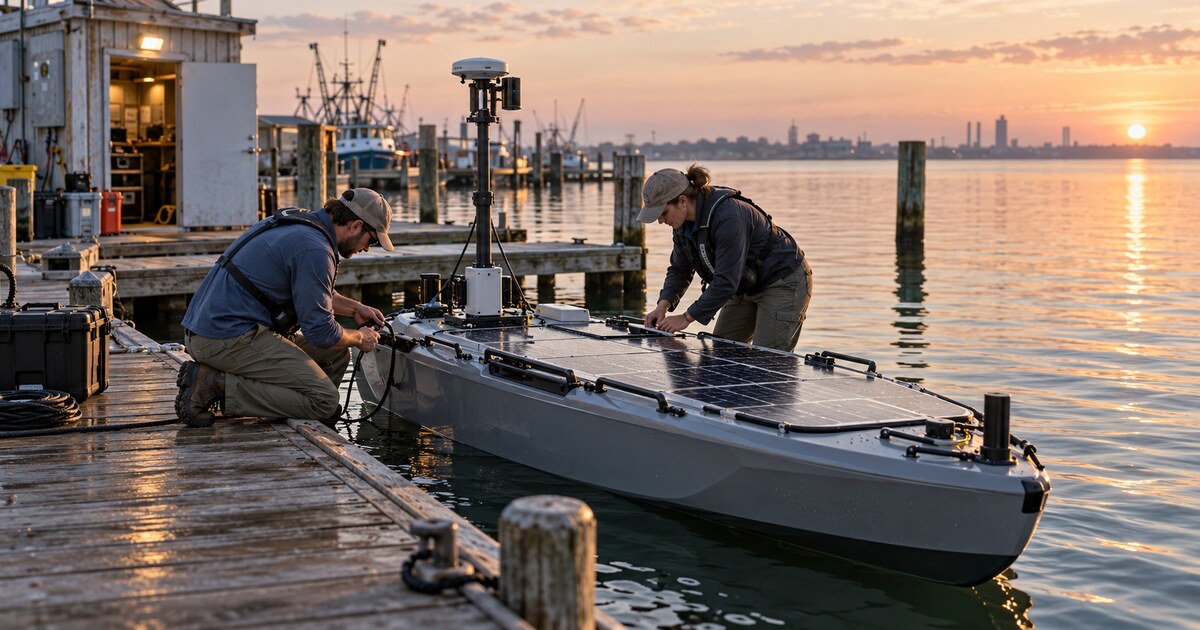
The Pentagon is considering a much larger fleet of small autonomous boats after testing Seasats Lightfish vessels along the Rio Grande and deploying them from the Texas coast.
The boats are not armed in the announced mission. They carry sensors, remain on the water for long periods and send tracking information to border and military systems.
What the Lightfish deployment includes
Seasats says each Lightfish is about 11 feet long, weighs roughly 340 pounds and can be launched by two people from a boat ramp or pickup truck. Solar power allows the vessel to remain deployed for months, according to the company.
The modular payload can carry electro-optical and infrared cameras, signals equipment and sonar. Reuters reported that data from the vessels feeds into Palantir's Maven Smart System and Anduril's Fortress platform, where it can alert Customs and Border Protection or Coast Guard units.
The current test group has 10 vessels. A US defence official told Reuters that orders could increase by as many as 50, with possible operations extending through the Gulf and later toward the Pacific coast. That expansion has not been finalized.
The performance numbers come from the Pentagon
The Pentagon says the boats assist with an average of 452 detections, 350 apprehensions and 100 turnbacks in a month. Those figures have not been independently audited in the public material reviewed by Mapletechie.
They also do not show how many events the boats detected on their own, how many would have been found by other patrols, or how often the system generated a false alert. A future procurement decision should include those measures, along with availability, maintenance and total operating cost.
Reuters put the approximate cost at US$240,000 per vessel. That figure does not necessarily include every sensor, software licence, network connection, support contract or staff member needed to act on an alert.
Why small boats are attractive
A patrol aircraft can cover a large area quickly but cannot remain over one location indefinitely. A small solar vessel moves more slowly and covers less water, but it can watch the same area for weeks or months without carrying a crew.
That persistence is useful for border monitoring, harbour security and tracking vessels in remote water. It also creates a privacy and oversight question because continuous collection can capture lawful activity as well as suspected smuggling.
The Canadian comparison
There is no indication that Canada is buying Lightfish vessels. Canada does, however, face a similar need to monitor long coastlines and northern approaches with limited crews and infrastructure.
The federal 2024 defence policy update committed $1.4 billion over 20 years for specialized maritime sensors. It also described a broader mix of surveillance and drone capabilities for the Arctic and Canada's three coasts.
Any Canadian evaluation of persistent autonomous boats would need to test cold-weather endurance, ice conditions, satellite coverage, repair access and communications at high latitudes. Northern and Indigenous communities would also need a clear role in decisions about where sensors operate and how collected data is used.
Mapletechie's recent look at government-owned satellite networks raised a related question: who controls the infrastructure and the information passing through it. A Canadian maritime system could still depend on foreign software, sensors and cloud services unless procurement terms define that control.
What is still unknown
The public reporting does not provide independently tested detection accuracy, false-alert rates, software costs or a final fleet order. Seasats has confirmed the deployment, but the proposed increase remains under consideration.
The next useful evidence will be a contract, an operational evaluation or audited results that separate the vessel's contribution from the rest of the border-surveillance system.
Sources
- Seasats: Lightfish deployment announcement
- Reuters: fleet size, cost and expansion discussions
- Department of National Defence: Canadian maritime-surveillance plans
Tags: Lightfish, Seasats, autonomous boats, border surveillance, defence technology