MDA Starts C$100M-Plus Antenna Work for IRIS²
Matthew Leo · Published October 31, 2026 · Canada Tech
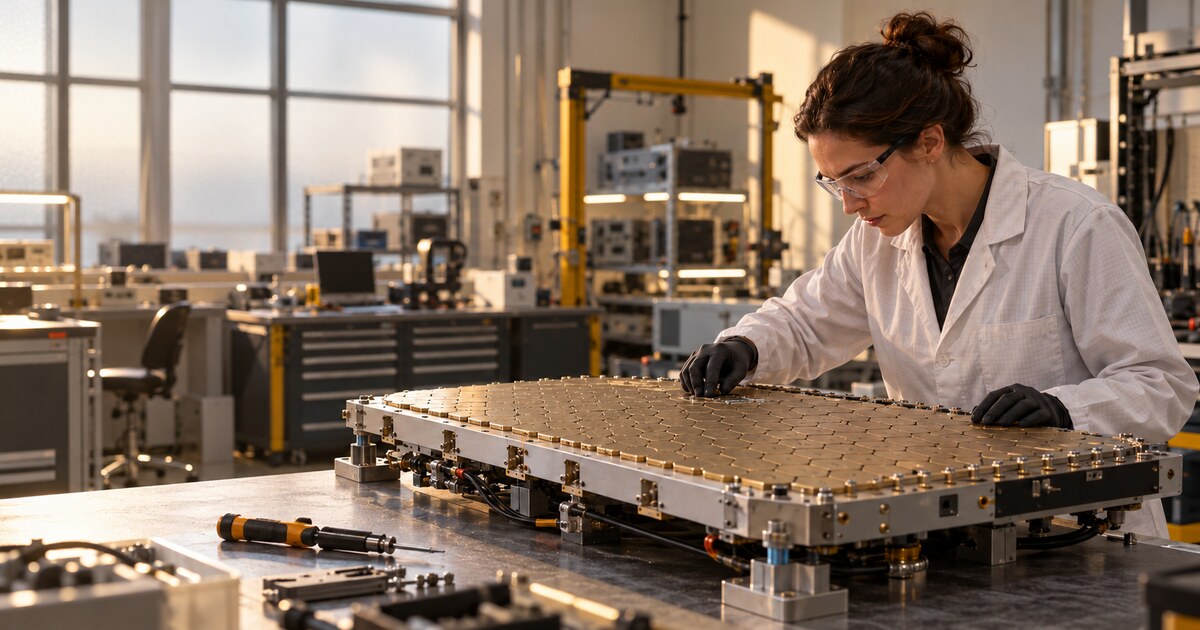
MDA Space has received initial authorization worth more than C$100 million to begin antenna work for 66 low-Earth-orbit satellites in Europe’s IRIS² secure-connectivity constellation. The Canadian contribution will be designed, manufactured and tested in Montréal.
The announcement is commercially important, but the wording matters. MDA describes the award as an authorization to proceed from Thales Alenia Space, not the final definitive contract for the complete program. The initial amount will enter MDA’s backlog in the fourth quarter of 2026.
What MDA is building
The work covers MDA Aurora broadband digital phased-array antennas and a digital antenna controller for the 66 “Layer 1” satellites. Those components electronically steer radio beams, allowing a satellite to direct capacity toward different regions without mechanically turning a dish.
Digital beamforming can also help a network reshape coverage as demand or mission priorities change. That flexibility is useful for a constellation intended to support government, commercial and security communications across a large area.
MDA says the 66 satellites are scheduled to begin launching in 2029. Via Satellite independently confirmed the supplier role and the 66-satellite scope. Canadian specialist publication SpaceQ also reported that the work connects MDA to the early-delivery layer of the program.
Why IRIS² matters
IRIS² stands for Infrastructure for Resilience, Interconnectivity and Security by Satellite. The European Union is building it as a sovereign connectivity system designed to serve government users and support commercial broadband services.
That gives the project a role beyond ordinary satellite capacity. Governments increasingly view secure communications, navigation and Earth observation as infrastructure that must remain available during outages, conflict or political disruption.
Mapletechie’s earlier report on Canada’s backing for a resilient satellite-navigation alternative covered the same strategic pressure from a different angle: countries want more than one way to communicate and locate critical assets when terrestrial or legacy satellite systems are degraded.
The Canadian industrial angle
The immediate Canadian value is high-skilled engineering and manufacturing work in Montréal, plus a supplier position in a large European space program. If MDA performs well on the first layer, the relationship could also create follow-on opportunities as IRIS² expands.
It is too early, however, to treat the full future value as booked revenue. The announced authorization covers initial work, and MDA says it expects to add that amount to backlog in the current quarter. Final scope, later satellite layers and potential options remain separate commercial questions.
The timing also overlaps with closer Canada–EU cooperation on secure connectivity and space. The October 30 summit statement says the two sides will explore Canadian participation in IRIS² and possible access to Galileo services. MDA’s supplier role is a concrete industrial connection even before those government discussions produce a broader agreement.
What could change the value of the award
Final contract scope: the definitive agreement may adjust quantities, schedule, technical requirements or commercial terms.
Constellation schedule: satellite programs can move as spacecraft, launch and ground-segment dependencies mature.
Production execution: phased-array manufacturing depends on component supply, testing yield and repeatable quality at scale.
Later layers: the first 66 satellites do not represent the entire long-term IRIS² architecture.
What to watch next
The next useful disclosures will be the final contract, production milestones in Montréal and any additional orders beyond the first 66 satellites. Investors and policymakers should distinguish signed backlog from the larger strategic promise of the constellation.
For Canada, the strongest signal is not simply the C$100-million figure. It is that a domestically developed antenna platform has won a place inside Europe’s secure-connectivity buildout. The test now is whether the initial authorization becomes repeatable production and a durable export role.
Tags: Canada, space, satellite connectivity, defence technology, manufacturing