NATO Tested Battlefield 5G—and Some of It Failed
Matthew Leo · Published November 6, 2026 · Canada Tech
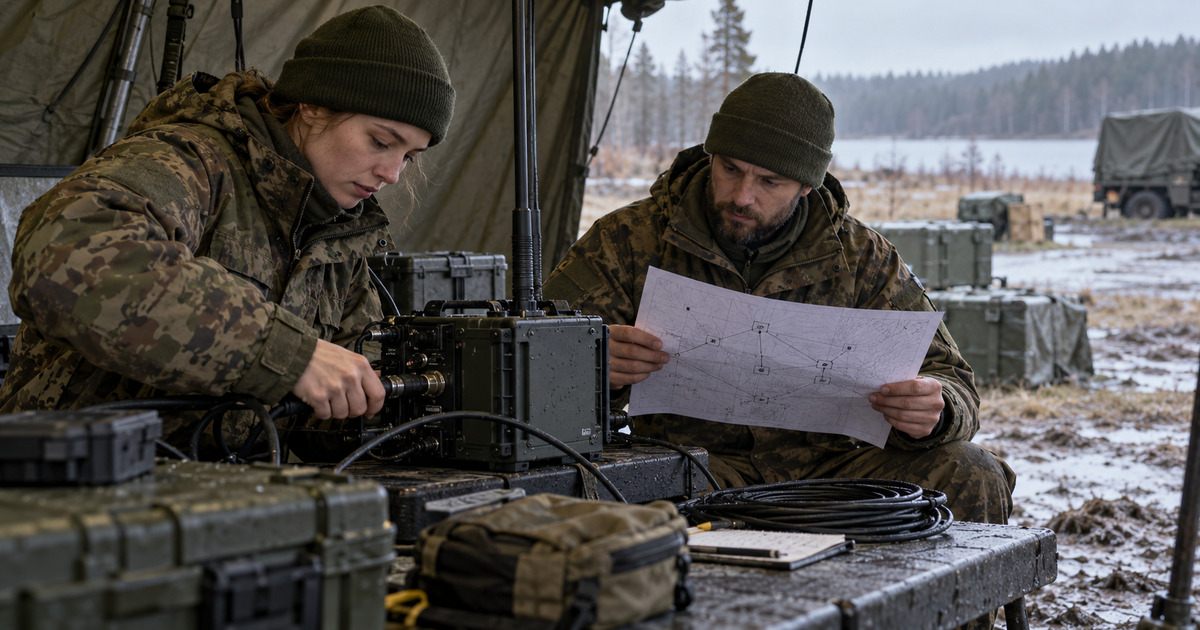
NATO has finished a two-week experiment in Latvia that connected commercial 5G networks, military radios, satellite links, drone detection and targeting systems. Some parts did not work as planned.
That is not a footnote to hide. It is the point of testing unfamiliar technology before commanders depend on it in a real operation.
The event, called NATO FUSE, joined two experimentation programs: the Digital Backbone Experiment, or DiBaX, and the Land Capability Integration Experiment. Canada has a direct reason to pay attention because Canadian forces lead NATO's multinational brigade in Latvia.
What NATO actually tested
NATO Allied Command Transformation says the experiment combined resilient communications with counter-drone and targeting work. The demonstrations included drone swarms, simulated electronic warfare, passive detection using 5G signals and connections between sensors and command networks.
The NATO Communications and Information Agency provides a more specific list. Teams tested 5G network slicing, communication across multiple networks, passive object detection, 5G connected to a European Space Agency satellite link, counter-drone integration and ways to avoid radio-spectrum conflicts.
These are experiments, not declarations of operational readiness. NATO has not said that a brigade can now replace its military communications with a public mobile network.
Commercial 5G adds options, not immunity
A commercial network can provide coverage, bandwidth and equipment that already exists in the region. Network slicing may also reserve capacity or apply different policies to a particular group of users.
But the physical towers, power, fibre backhaul, software and management systems remain part of the risk. A capable adversary can jam radio frequencies, damage infrastructure, attack administration systems or observe patterns of use.
Military users therefore need several paths that fail differently. A 5G link may carry video while available, then hand work to satellite, radio or another network when conditions change. The hard problem is not simply connecting each component. It is keeping identity, priorities and command authority intact while the route changes.
Failure was useful evidence
Vanguard Defence reported that parts of the demonstration stumbled and that commanders treated those failures as useful findings. That is a healthier interpretation than presenting a polished demonstration as proof of a finished capability.
A field experiment should expose incompatible equipment, weak handoffs, confusing operator procedures and spectrum conflicts. If those problems only appear during deployment, the cost is much higher.
What Canada should ask next
Canada commands the brigade and has roughly 2,000 personnel in Latvia, according to Vanguard Defence. The next questions should be practical:
- Fallback: which tasks continued when a 5G or satellite path failed?
- Identity: could users and devices authenticate across military and commercial networks without sharing excessive privileges?
- Spectrum: did counter-drone equipment interfere with friendly communications or sensors?
- Supply chain: who can update, inspect and replace the commercial components in theatre?
- Evidence: what measurements will decide whether a prototype advances to a larger exercise?
The answers matter to Canadian procurement as well as operations. Buying a promising radio or sensor is easier than integrating it with allied networks, training maintainers and sustaining it through interference and damage.
Mapletechie's guide to drone detection and Canadian jamming law explains why passive detection and active disruption are different legal and technical decisions. Its backup communications guide offers the civilian version of the same principle: redundancy only counts after a real test.
NATO FUSE is valuable because it produced evidence instead of a promise. The next test is whether the alliance publishes enough of that evidence to improve future designs without exposing sensitive operational details.
Tags: NATO, 5G, Latvia, defence technology, Canada