Read a Shelter-in-Place Alert Before You Move
Matthew Leo · Published October 23, 2026 · Guides

A shelter-in-place alert is an instruction to get safer by staying indoors, but it is not a universal command to head for the basement. The safest room depends on the hazard. Your first move should be to read the full alert, not rely on the sound, a screenshot or a social-media repost.
Canada’s National Public Alerting System distributes area-specific warnings created by authorized emergency-management organizations. Those can include police, Environment and Climate Change Canada, and provincial or territorial authorities. The message should identify the hazard, affected area and action.
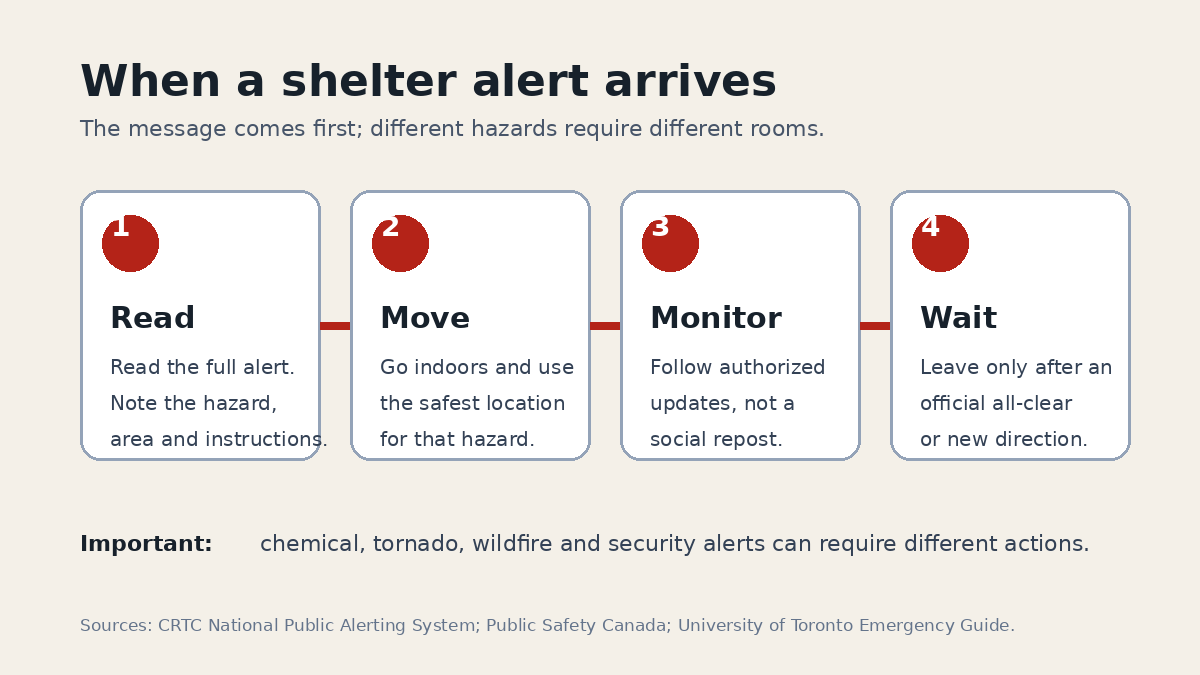 A useful response has four stages, but the alert’s hazard-specific instructions always take priority. Sources: CRTC, Public Safety Canada and the University of Toronto Emergency Guide.
First: read for three facts
Before moving, find these details in the alert:
The hazard: Is it severe weather, smoke, a chemical release, a police incident or something else?
The area: Are you inside the affected zone? Geo-targeting is useful but not precise enough to replace the written boundary.
The instruction: Does the issuer say to remain indoors, avoid a route, turn off ventilation, move to a lower level or prepare to evacuate?
If the alert is truncated, check an official provincial or territorial emergency page, local police or emergency-management account, broadcaster, or the issuer named in the message. Do not drive toward the affected area to get better information.
Second: choose a room that matches the hazard
For many outdoor hazards, moving indoors and closing doors and windows reduces exposure. A small interior room away from windows is a sensible default while you read further instructions.
It is only a default. The University of Toronto’s emergency guide illustrates why hazard type matters:
Chemical threat: An above-ground room may be preferable. Turn off fans, air conditioning and heating if authorities instruct you to isolate outside air, and close ventilation openings as directed.
Tornado: A basement or small interior ground-floor room is generally preferable. Stay away from windows, doors and outside walls.
Police or security incident: Follow police instructions. Lock or secure doors only if the alert says to do so, silence devices if safety requires it, and do not post responder locations.
Wildfire smoke: Move inside, close windows and follow local public-health advice about filtration and air quality. Be ready to evacuate if the order changes.
Do not improvise hazard-specific measures from memory when the alert provides different directions.
Third: keep an official update path open
An emergency message is a starting point. Conditions can change from sheltering to evacuation, or the affected area can expand.
Keep at least one phone charged, but use more than one channel when possible: radio, television, an official website and local emergency notifications. Conserve battery by lowering screen brightness and avoiding unnecessary video. If networks are congested, text messages may succeed when calls do not.
Canada’s system sends alerts to compatible phones connected to LTE or newer mobile networks, and also distributes them through television and radio. Mapletechie’s earlier guide explains how to check that emergency alerts can reach your phone.
Do not approach debris or suspicious objects
If an alert concerns an aircraft, drone, explosion or unknown object, keep your distance. Do not touch, move or photograph it at close range. Call 911 if there is an immediate danger or the alert directs you to report sightings; otherwise use the local non-emergency channel given by authorities.
This matters because debris can contain fuel, batteries, sharp material or explosive components. It may also be evidence needed to identify the object and reconstruct what happened.
Leave only after the instruction changes
Do not assume silence means the danger has passed. Remain inside until emergency personnel or an authorized update gives an all-clear, unless the building itself becomes unsafe.
Once the order is lifted, watch for follow-up advice about air quality, road closures, contaminated surfaces or damaged utilities. If anyone has symptoms after a chemical or smoke event, contact medical services and describe the exposure rather than simply saying there was an alert.
Prepare a five-minute shelter kit
Keep a small kit where you would shelter: water, essential medication, a flashlight, a battery radio, a charging cable and power bank, basic first aid, masks appropriate for smoke or dust, and copies of important contact details. Add supplies for children, older adults and pets.
The point is not to build a bunker. It is to avoid leaving a safer room for routine items while authorities are still assessing the hazard.
The CRTC explains who issues Canadian alerts and how they are distributed. Public Safety Canada describes the national alerting system, and the University of Toronto emergency guide provides practical examples of how shelter choice changes by hazard.
Tags: Alert Ready, shelter in place, emergency preparedness, Canada, public safety